
Freelancer Hourly Rate in Germany 2026: Formula, Examples and Realistic Numbers
€103 is the 2026 average for German freelancers — but your real rate depends on utilization, taxes and pension. Here's the formula that actually works.
- Category
- Business
- Updated
- Author
- Diana
Every freelancer in Germany faces this question with a thud: what do I charge per hour? In 2026 the market average reported by the Freelancer Compass is €103/h — IT consultants reach €121/h, web developers €91/h. Picking a rate from the market average alone ignores the reality of self-employment in Germany: you pay all your own social security, taxes and pension. Here is how to calculate a rate that actually leaves money in your pocket.
The short answer
- Formula: Hourly rate = (target net + taxes + social security + business costs + reserves) ÷ sellable hours.
- Sellable hours are not 2,080 but ~1,180 per year — vacation, sickness, holidays and non-billable time eat the rest.
- Market 2026: the average sits at €103/h and has dipped for the first time in years (from €104).
- Worked example: €95,000 annual requirement ÷ 1,180h = €80.50/h net, plus 19 % VAT = €95.80/h gross.
- Rule of thumb: budget at least 40–50 % of revenue for taxes and social security — otherwise you price yourself poor.
Why your target income is not your hourly rate
Many freelancers take a target gross salary — say €60,000 — and divide by 2,000 hours: €30/h. The math ignores three realities. You cannot be 100 % billable. You pay all social security yourself. And you need reserves for sickness, vacation and dry months. An employee on €60,000 gross actually costs the employer about €75,000 — as a freelancer you carry that overhead plus a risk premium yourself.
The formula: how to calculate your hourly rate
Hourly rate = (target net income + taxes + social security + business costs + reserves) ÷ sellable hours per year. Each line needs to be estimated on its own, or the result lands hundreds of euros off per month:
| Line item | What goes in | Rule of thumb |
|---|---|---|
| Target net income | What you want left to live on | e.g. €36,000/year (€3,000/month) |
| Income tax + Soli | On profit, not revenue | ~25–35 % of profit |
| Health & long-term care insurance | Voluntarily statutory or private | 14–17 % of profit, €250+/month minimum |
| Pension provision | Or you slide into old-age poverty | 10–15 % of profit |
| Business costs | Software, office, equipment, accountant, liability | individual |
| Reserves | Sickness, vacation, dry months, investments | 10–15 % on top |
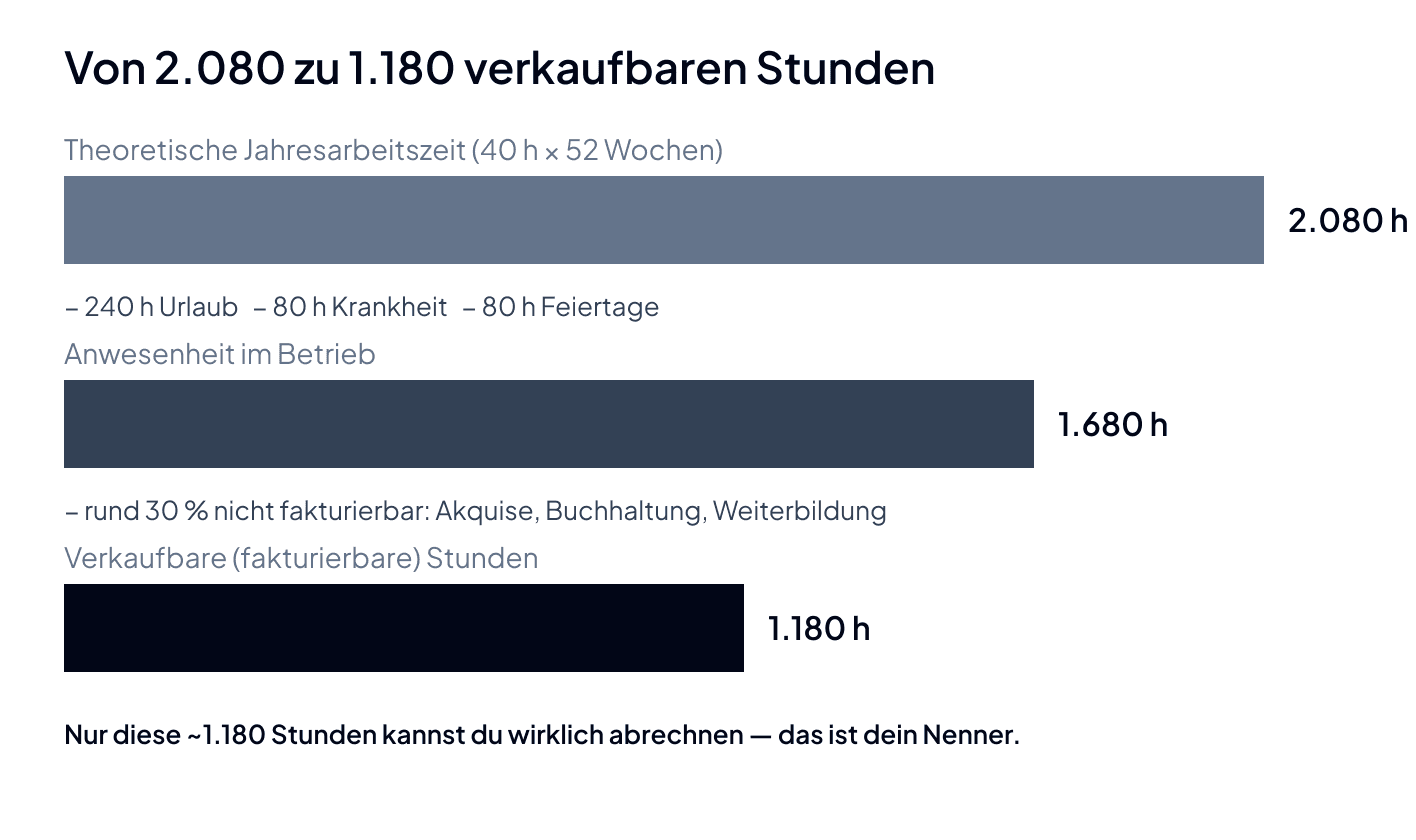
Sellable hours: 1,180 instead of 2,080
40 × 52 = 2,080 hours sounds plausible but is fiction. Nobody bills every on-the-clock hour — sales, bookkeeping, training and breaks take a large share. Here is how the number melts down:
| Position | Hours |
|---|---|
| Gross (40h × 52 weeks) | 2,080 |
| − 30 vacation days | −240 |
| − ~10 sick days | −80 |
| − ~10 public holidays | −80 |
| = On-the-clock presence | 1,680 |
| − ~30 % non-billable (sales, bookkeeping, training) | −500 |
| = sellable hours | ~1,180 |
These ~1,180 hours are the honest denominator of your calculation. Divide by 2,080 instead and you set your rate at nearly half the level you actually need.
Worked example: hourly rate step by step
Take a consultant who wants to keep €36,000 net per year. We add up every line to her annual requirement and divide by sellable hours:
| Line item | Amount per year |
|---|---|
| Target net income | €36,000 |
| Income tax + Soli | €14,000 |
| Health & long-term care insurance | €9,000 |
| Pension provision | €9,000 |
| Business costs | €12,000 |
| Reserves (buffer) | €15,000 |
| = Annual requirement | €95,000 |
| ÷ 1,180 sellable hours | €80.50/h net |
| + 19 % VAT | €95.80/h gross |
So €80.50 net is not a luxury — it is the cost price for a €3,000/month take-home. The €95.80 gross is the figure on your invoice; the VAT passes straight through to the tax office.
Realistic 2026 rates by industry
The 2026 Freelancer Compass and ongoing market data report for the main activities:
| Activity | Hourly rate 2026 |
|---|---|
| IT consulting & management | €121/h |
| Software & web development | €91/h |
| Architecture / dev lead | €110–130/h |
| UX/UI design | €80–100/h |
| Copywriters & content | €60–90/h |
| Bookkeeping & tax | €70–110/h |
| Coaches & trainers | €100–180/h |
| Average across all industries | €103/h |
These are orientation, not a tariff. If your calculated cost price sits above the industry average, that is a signal — for more efficiency, sharper positioning or a different client type. Going below your own cost price never solves it.
What else the Freelancer Compass 2026 shows
The market tightened in 2026 — that changes your negotiating position, not your cost calculation:
| Freelancer Compass 2026 metric | Value |
|---|---|
| Avg hourly rate | €103 (prior year €104) |
| Avg monthly income | €6,653 (−17 % year over year) |
| Avg weekly hours | 42h (prior year 40h) |
| Billable fewer than 50 days | 24 % of freelancers |
| Plan no rate increase in 2026 | 62 % |
For the first time since the survey began, the average rate did not rise, and monthly income actually fell sharply — while hours went up. The lesson: when utilization drops, hold your rate and step up sales rather than going below your cost price. Whoever starts cheap rarely climbs back up.
Taxes and social security — what gets forgotten
As a freelancer or self-employed person in Germany you pay yourself:
- Income tax + solidarity surcharge (on profit, not revenue)
- Trade tax if you are a Gewerbetreibender (€24,500 allowance)
- VAT (passes through but matters for cash flow — see VAT deadlines 2026)
- Health insurance and pension provision — see Pension and health deductions for the self-employed
- Professional liability insurance and, for creatives, the Artists' Social Fund (KSK)
Budget at least 40–50 % of revenue for taxes and social security. Read more on estimated tax payments in our companion guide.
The starter book for your self-employment
Free e-book: registration, accounting, your first invoice, and taxes — plus a tax calendar, deductions cheat sheet, and invoice template.
Hourly vs. day rate vs. fixed price
- Day rate = hourly × 8 (often with 5–10 % discount for longer bookings)
- Fixed price = estimated hours × hourly × 1.2 risk buffer
- Long-term project discount: cap at 10–15 %, otherwise margin disappears
For larger projects, work with milestone payments — our practical guide on down-payment and final invoices walks through the mechanics.
The lever that helped me the most was getting deeper in the niche. I started getting good at e-commerce plugins and, at some point, started taking only these projects. I was able to double my rate and build better customer relationships than at the start, when I was ready to take on any type of development work.
 Stan KharlapFounder of Norman
Keep your hourly rate in view with Norman
An hourly rate is only right if it still holds after taxes and social security — and you only see that once income and costs flow together cleanly. With Norman you invoice for free, including mandatory e-invoicing, sort expenses automatically, and watch month by month how much of your rate is actually left as net. That way you notice early when the rate needs adjusting down — before the year is gone.
Frequently asked questions about freelancer hourly rates
What is a good hourly rate for freelancers in 2026?
The market average is €103/h in 2026, roughly €60 to €180 depending on field. But "good" is not the average — it is the rate that covers your living costs, taxes, pension and reserves, divided by your sellable hours. If your cost price is above that, you need sharper positioning; below it, you have room.
How many hours can I actually bill per year?
Realistically about 1,100 to 1,500 sellable hours, not the theoretical 2,080. Of 1,680 on-the-clock hours (after vacation, sickness and holidays), only 60–80 % are billable depending on field — the rest goes to sales, bookkeeping and training.
How do hourly and day rates differ?
A day rate is essentially the hourly rate × 8, often with a 5–10 % discount for longer bookings. Day rates are common in consulting and project work, hourly rates for smaller or fluctuating jobs. The 2026 market day-rate average is about €824 — which matches the €103 hourly rate.
When is a fixed price better than an hourly rate?
A fixed price pays off when the effort is predictable and you work efficiently — then you earn on your speed. Calculate it as estimated hours × hourly rate × 1.2 risk buffer. For unclear scope or frequent change requests, an hourly rate is fairer and safer.
Do I have to add VAT to my hourly rate?
Yes, unless you are a small business under § 19 UStG: 19 % VAT goes on top of the net hourly rate. €80.50 net becomes €95.80 gross. VAT is a pass-through item for you — you forward it to the tax office.
What percentage of revenue should I set aside for taxes?
Budget at least 40–50 % of revenue for income tax, social security and VAT. The simplest approach is to transfer that share off every payment into a separate account — so the money is not lying around and the next tax prepayment does not catch you unprepared.
Conclusion
A realistic hourly rate doesn't start at market price — it starts with your needs: living costs, taxes, pension, reserves, divided by an honest 1,100–1,500 sellable hours. Remember:
- Calculate from your needs, not the industry average.
- Use ~1,180 sellable hours as the denominator, not 2,080.
- Set aside 40–50 % for taxes and social security right away.
- Hold your rate even in the tighter 2026 market — sales beats dumping.
Most freelancers underprice themselves by 20–30 %. Norman gives you free invoicing with mandatory e-invoicing built in, so you can see month by month whether your rate still works after taxes.
Norman handles the operational finance work behind the scenes
From invoicing to bookkeeping, Norman keeps recurring finance work organized so you can stay on top of deadlines with less manual effort.