
Freelancer vs. Trader in Germany: Are You a Freiberufler or Gewerbetreibender?
When going self-employed in Germany, one of the first questions is: are you a Freiberufler (freelancer) or a Gewerbetreibender (trader)? The distinction carries significant tax and administrative consequences.
- Category
- Founding
- Updated
- Author
- Diana
When you start working for yourself in Germany, one of the first questions is: are you a Freiberufler (freelancer practicing a liberal profession) or a Gewerbetreibender (trader running a commercial business)? Both are self-employed, but German tax law treats them very differently — affecting whether you pay trade tax, what records you must keep, and whether you need to register a Gewerbe.
The Short Answer
- Freiberufler (§ 18 EStG): liberal professions — the catalog professions (doctor, lawyer, engineer, architect …) plus scientific, artistic, literary, teaching, and educational work. No trade registration, no trade tax, no mandatory IHK membership.
- Gewerbetreibender (§ 15 EStG): trade, crafts, manufacturing, hospitality, many e-commerce activities. Trade registration is mandatory, trade tax applies above €24,500 of trade profit, IHK membership is compulsory.
- What matters is the activity, not the title — and the Finanzamt makes the final decision via the tax-registration questionnaire.
- In borderline fields (e.g. IT, consulting), the test is whether the work is primarily intellectual-creative and requires academic or comparable qualifications.
- Mixed activity in a GbR? Watch out for the Abfärbetheorie (contamination rule) — even a small commercial share can make the whole activity commercial.
The Core Distinction: § 18 vs. § 15 EStG
German income tax law defines two categories of self-employment:
- Freiberufler (§ 18 EStG): Practice a liberal profession — scientific, artistic, literary, teaching, or educational work, plus the so-called Katalogberufe (listed professions). Exempt from Gewerbesteuer (trade tax) and from registering a Gewerbe.
- Gewerbetreibender (§ 15 EStG): Runs a commercial business — trade, craft, retail, hospitality, many e-commerce activities. Must register a Gewerbe and may owe Gewerbesteuer.
Both earn either "income from self-employed work" or "income from a trade" — and that label decides your bureaucracy and tax burden. Crucially, it is not a free choice. You cannot declare yourself a Freiberufler just because it's cheaper. What counts is what you actually do.
Freiberufler vs. Gewerbetreibender at a Glance
| Feature | Freiberufler (§ 18 EStG) | Gewerbetreibender (§ 15 EStG) |
|---|---|---|
| Legal basis | § 18 EStG | § 15 EStG |
| Trade registration | Not required, Finanzamt only | Mandatory at the Gewerbeamt (approx. €15–65) |
| Trade tax (Gewerbesteuer) | Exempt | Above €24,500 trade profit (rate 300–500%) |
| IHK / HWK membership | None | Mandatory, fee-paying |
| Tax-return schedule | Anlage S | Anlage G |
| Profit calculation | Always allowed to use EÜR | EÜR; balance sheet above €800,000 revenue or €80,000 profit |
| How you register | Tax-registration questionnaire | Gewerbeamt + questionnaire |
| Who decides | Finanzamt | Finanzamt (+ Gewerbeamt) |
Not sure which one fits you? Take our 2-minute test "Freelancer or trade?" — it classifies your activity as § 18 or § 15 EStG from a few questions and tells you what to do next.
Which Professions Qualify as Freiberufler?
The law lists specific professions (Katalogberufe) that automatically qualify:
- Doctors, dentists, veterinarians, alternative practitioners (Heilpraktiker)
- Lawyers, notaries, tax advisors, auditors
- Architects, engineers, surveyors
- Journalists, writers, translators, interpreters
- Scientists, teachers, educators
Beyond these, the law recognizes "similar professions" — which can include many IT consultants, designers, and management consultants, depending on the specifics of their work. The tax office decides on a case-by-case basis. The key test: is the work primarily intellectual and creative in nature, requiring academic or equivalent expertise? You must also work in a leading and self-responsible capacity (leitend und eigenverantwortlich) — you may employ professionally trained staff, but must shape the work through your own expertise (§ 18 (1) no. 1 EStG).
For the full breakdown of catalog and activity-based professions, see our list of liberal professions in Germany.
What Makes Someone a Gewerbetreibender?
You run a commercial business if you operate independently, continuously, and with profit intent — and don't qualify as a liberal profession. Typical examples: online retailers, craftspeople, restaurateurs, many app developers (when they sell products rather than provide advisory work).
As a Gewerbetreibender, you must register your business at the Gewerbeamt (one-time fee of roughly €15–65 depending on the city). If your annual trade profit exceeds €24,500, you owe Gewerbesteuer (trade tax) — at a rate that varies by municipality (typically 300–500% of the base rate).
Why the Distinction Matters for Taxes
The classification affects several areas of your business:
- Trade tax (Gewerbesteuer): Only Gewerbetreibende pay it — and only above a trade profit of €24,500 (the allowance for sole traders and partnerships). Freiberufler are fully exempt. For sole traders, the credit against income tax (§ 35 EStG) often largely offsets the burden anyway.
- Business registration: Required for Gewerbetreibende, not for Freiberufler. Freiberufler register only with the Finanzamt.
- IHK membership: Gewerbetreibende automatically become mandatory (fee-paying) members of the local Chamber of Commerce (IHK) or Chamber of Crafts. Freiberufler do not — some professions have their own chamber instead (e.g. doctors, lawyers).
- Accounting obligations: Freiberufler may always use the simple cash-basis EÜR regardless of profit. Gewerbetreibende with revenue over €800,000 or profit over €80,000 must use full double-entry bookkeeping (a balance sheet).
One thing is independent of your status: both can use the Kleinunternehmer (small-business) VAT exemption. Freiberufler vs. Gewerbe is a question of your income category — Kleinunternehmer vs. standard VAT is a separate VAT question.
The Typical Borderline Case: IT, Consulting & Co.
Disputes with the Finanzamt most often concern IT and consulting roles. The line runs roughly like this: those who design individual, sophisticated software solutions in an engineering-like or advisory way are often recognized as freiberuflich (akin to the catalog profession of engineer). Those who mostly build standard websites, sell hardware, or resell off-the-shelf software licenses are usually commercial.
Pure training and coaching is also often classified as commercial, even when bundled into a consulting package. Worth knowing: the Finanzamt can reclassify you years later — for example after a change of case officer or at your first tax return. So it pays to document a clean justification from the start.
Mixed Activity: Beware the Contamination Rule
Some self-employed people do both — for example, a software developer who also sells a software product. Here the legal form is decisive:
- Sole traders can keep both activities separate and tax them separately — provided they are objectively and organizationally separable (separate records, separate invoice number ranges, clear demarcation of services).
- Partnerships such as the GbR are hit by the Abfärbetheorie (contamination rule) (§ 15 (3) no. 1 EStG): even a small commercial component can cause the entire activity to be classified as a Gewerbe — with all the tax consequences.
Exception (de-minimis threshold): if commercial net revenue is under 3% of total revenue and does not exceed €24,500/year, the Freiberufler status is preserved (per the Federal Fiscal Court). If you do both in a GbR, consider moving the commercial activities into a separate entity.
How to Determine Your Status
The Finanzamt makes the final determination. For a first self-assessment, these questions help:
- Do I belong to one of the listed Katalogberufe (doctors, lawyers, architects, engineers, journalists, teachers …)?
- Is my work primarily intellectual and creative, requiring academic or equivalent expertise?
- Do I work in a leading and self-responsible capacity based on my own expertise?
- Am I selling my knowledge and labor — or products and goods?
If in doubt, ask your Finanzamt or consult a tax advisor. A binding ruling (verbindliche Auskunft) gives legal certainty — for a fee. Best clarify your status before you issue your first invoice: a later reclassification can trigger back-payments for several years.
The starter book for your self-employment
Free e-book: registration, accounting, your first invoice, and taxes — plus a tax calendar, deductions cheat sheet, and invoice template.
Being Gewerbe isn't the end of the world and actually has benefits. Trying to fit your business into unrelated boundaries would cost you flexibility, growth, and peace of mind.
 Peter BoykoFounder of Norman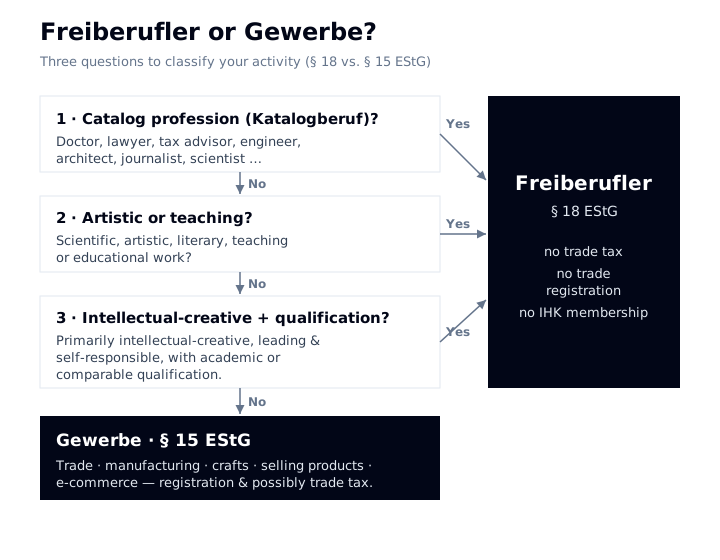
FAQ
Which is better — Freiberufler or Gewerbe?
Purely from a tax standpoint, the Freiberufler status is usually cheaper: no trade tax, no trade registration, no IHK fees, and always the simple EÜR. But "better" doesn't mean "freely chosen" — what counts is what you actually do. If you run a trade, you can't declare yourself a Freiberufler.
Can I choose whether I'm Freiberufler or Gewerbe?
No. The classification follows the nature of your activity, not your preference. The Finanzamt assesses, via the tax-registration questionnaire, whether you fall under § 18 or § 15 EStG.
As a programmer or IT consultant, am I a Freiberufler?
It depends on the specific activity. Those who design individual, sophisticated software in an engineering-like or advisory way can be freiberuflich. Those who mainly sell standard solutions, hardware, or off-the-shelf licenses are usually commercial. The Finanzamt decides case by case.
Do Freiberufler really pay no trade tax?
Yes, Freiberufler are exempt from trade tax. Gewerbetreibende pay it only above €24,500 of trade profit (the allowance for individuals and partnerships); the municipal rate is usually 300–500%.
What happens if the Finanzamt reclassifies me?
If the Finanzamt retroactively classifies an originally freiberuflich activity as commercial, you must register a Gewerbe and may owe trade tax for the affected years. Clean documentation and, in borderline cases, a binding ruling protect you.
Can I be both freiberuflich and commercial at the same time?
Yes. As a sole trader you can keep both activities separate and tax them separately. In a GbR, take care, because the contamination rule can apply and then all income becomes commercial.
Conclusion
The Freiberufler vs. Gewerbetreibender distinction is not a formality — it determines your tax burden, bookkeeping obligations, and administrative workload. Clarify your status early, ideally before issuing your first invoice. Getting it right from the start saves stress and avoids back-payments later. Whether Anlage S or Anlage G: Norman handles invoices, receipts, bank reconciliation, VAT returns, and the EÜR automatically — bookkeeping and invoicing are free.
Norman handles the operational finance work behind the scenes
From invoicing to bookkeeping, Norman keeps recurring finance work organized so you can stay on top of deadlines with less manual effort.