
How to Form a GmbH in Germany 2026: Costs, Process and Step-by-Step Guide
Want to form a GmbH in Germany? Here is the complete process from share capital and notary appointment to trade register entry — plus when a GmbH is actually worth it, including all costs and obligations for 2026.
- Category
- Founding
- Updated
- Author
- Diana
The GmbH is Germany's most popular corporation — but also one of the more demanding legal forms. Before you book the notary appointment, ask the honest question: do you really need a GmbH, or would a UG or sole proprietorship do? This guide answers both: from what point a GmbH pays off, and how the formation works in practice in 2026.
Key Takeaways
- Share capital: at least €25,000, of which €12,500 must be paid in at formation.
- Formation costs: roughly €800 to €2,500 (notary, trade register, trade office) — on top of the share capital.
- Duration: usually 2 to 6 weeks from notary appointment to registration; online formation can be faster.
- Worth it from: roughly €80,000–€100,000 in sustained annual profit — and only if you retain profits in the company.
- Tax: retained profits ~30%, but on full distribution the burden rises to ~48%.
- Obligations: double-entry bookkeeping, balance sheet, annual statements in the Federal Gazette, corporate and trade tax.
What Is a GmbH?
The Gesellschaft mit beschränkter Haftung (GmbH) is Germany's most popular form of limited liability company. It offers founders liability protection limited to company assets — your personal wealth stays protected. With over 500,000 active GmbHs, it is the standard choice for entrepreneurs who want a professional image and limited risk.
As a legal person, the GmbH is itself the contracting party, employer and taxpayer. It is generally liable only with its own assets — not with the shareholders' private wealth. This separation is the central advantage over a sole proprietorship, where you are personally and unlimitedly liable.
When Is a GmbH Worth It?
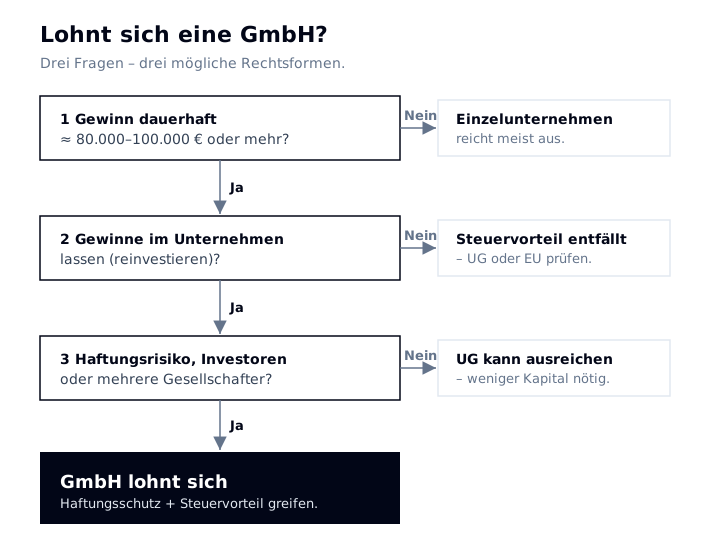
A GmbH is not automatically the best legal form — it creates ongoing costs and obligations that only pay off above a certain size. A GmbH is worth it especially when several of these factors apply:
- Real liability risk: you sign five-figure contracts, are liable for products, or work on long projects with high damage potential.
- Stable, high profit: as a rule of thumb, a GmbH becomes tax-attractive from around €80,000 to €100,000 in sustained annual profit — but only if you retain profits in the company.
- Multiple shareholders: clear stakes and voting rights are cleanly defined in a GmbH.
- Investors or exit planned: equity stakes, share transfers and a later sale are standard in a corporation.
Conversely, a GmbH is often too early when your profit is low or volatile, the risk stays minimal, or you are still testing the idea. In those cases a sole proprietorship or a UG is usually the cheaper choice — you can always convert from a sole proprietorship into a GmbH later.
The Tax Comparison: GmbH vs. Sole Proprietor
The decisive lever is whether you withdraw or retain profits. If the GmbH retains its profits (retention/Thesaurierung), it pays only corporate income tax (15% plus the solidarity surcharge) and trade tax — together around 30%. A sole proprietor taxes the same profit at the progressive income tax rate of up to 45%.
| Burden on €100,000 profit | Sole proprietor | GmbH (retained) | GmbH (fully distributed) |
|---|---|---|---|
| Tax type | Income tax + soli, trade tax (with credit) | Corporate tax + soli + trade tax | + capital gains tax on distribution |
| Effective burden | approx. 33–35% | approx. 30% | approx. 45–48% |
The figures are illustrative — a sole proprietor's actual burden depends on marital status, other income and the municipal trade tax multiplier. The core point stands: the GmbH advantage comes from low tax on retained profits — distribute everything and double taxation cancels it out. If you want to reinvest profits, you benefit; if you need everything privately, often not.
For more on GmbH taxation, see our guides to corporate income tax and the managing director salary, which lets you steer profit legally.
This is a simple decision, because it shouldn't be based on vibes or whether you feel like it. Opening a GmbH is complicated and expensive. It only makes sense if you really need it for one of the reasons listed here. Otherwise, it's not worth it.
 Peter BoykoFounder of Norman
GmbH vs. UG: Which Is Right for You?
The key difference is share capital: A GmbH requires at least €25,000, while a UG (haftungsbeschränkt) can be formed with as little as €1. However, the UG must retain 25% of its annual profit until the €25,000 threshold is reached — after which it can re-register as a GmbH.
| Criterion | GmbH | UG (haftungsbeschränkt) |
|---|---|---|
| Minimum share capital | €25,000 (€12,500 at formation) | from €1 |
| Liability | limited to company assets | limited to company assets |
| Profit reserve | none required | 25% until €25,000 reached |
| Public image | high credibility | sometimes seen as a "mini-GmbH" |
| Notary & bookkeeping | mandatory | mandatory |
A GmbH is the better choice when you have sufficient starting capital, want maximum credibility with banks, partners and clients from day one, and plan to raise investment or handle larger contracts. For a detailed comparison, see UG vs GmbH compared.
Requirements for Forming a GmbH
- At least one shareholder — a natural or legal person. A single-person GmbH is allowed.
- €25,000 share capital — at least €12,500 (half) must be paid in at formation.
- A managing director (Geschäftsführer) — you can appoint yourself.
- Articles of association (Gesellschaftsvertrag) — must be notarized (see our guide to the articles of association).
- A registered business address in Germany.
Cash Formation or Contribution in Kind?
In most cases this is a cash formation (Bargründung): you pay the share capital in money. At registration, at least one quarter of each share and at least €12,500 in total must be paid in. Alternatively, a contribution in kind (Sachgründung) is possible — you contribute assets instead of cash (e.g. machinery, vehicles or receivables). A contribution in kind is more complex because the value of the assets must be documented in a formation report and reviewed by the register court.
Step-by-Step: How to Form a GmbH
1. Draft the Articles of Association
The articles of association (Gesellschaftsvertrag) define the company name, registered office, business purpose, share capital and shareholder stakes. For simple formations (up to three shareholders, one managing director), you can use the simplified model protocol (Musterprotokoll) — this saves on notary costs. For more complex setups, hire a lawyer to draft a custom document.
2. Notary Appointment
All shareholders must appear before a notary in person (or via a representative with power of attorney). The notary authenticates the articles, formally appoints the managing director and prepares the trade register application. Notary fees range from €600 to €2,000 — with the model protocol for a simple formation, often from around €800 including the application.
Since 2022, online formation is also possible: notarization runs via video conference through the notary portal, without you having to attend in person. This noticeably speeds up simple cash formations.
3. Open a Business Account and Deposit Share Capital
After notarization, open a business bank account in the name of the GmbH i.G. (in formation) and deposit at least €12,500. You will need the deposit confirmation for the trade register application. The remaining €12,500 can be paid in later, but remains a standing obligation. Important: the share capital is not frozen. Once the GmbH is registered, you can use it for ongoing business.
4. Trade Register Entry (Handelsregister)
The notary files the application with the local court (Amtsgericht). Processing typically takes 2 to 4 weeks — for online formation, registration must even happen within ten working days of a complete application. The GmbH officially exists only once registered. Until then, you operate as a GmbH i.G. with additional personal liability.
5. Trade License and Tax Registration
After registration, apply for a trade license (Gewerbeanmeldung) at your local trade office (€20–60). The tax office will send you a tax questionnaire where you declare estimated revenue and profits. You will then receive your tax number and VAT ID.
The starter book for your self-employment
Free e-book: registration, accounting, your first invoice, and taxes — plus a tax calendar, deductions cheat sheet, and invoice template.
Formation Costs at a Glance
| Item | Cost |
|---|---|
| Notary fees (notarization + application) | €600–2,000 |
| Trade register entry | approx. €150 |
| Trade license | €20–60 |
| Total formation costs | approx. €800–2,500 |
| Share capital (paid in at formation) | at least €12,500 |
In total, expect formation costs of €800 to €2,500 — on top of the share capital itself, which stays in the company and is not "lost." Note: many formation costs are tax-deductible — see our guide to deductible formation costs.
Ongoing Obligations After Formation
After formation, these obligations await you — they are the reason a GmbH only pays off above a certain size:
- Double-entry bookkeeping — a GmbH cannot use simplified cash-basis accounting. See our GmbH bookkeeping guide.
- Annual financial statements filed with the Federal Gazette — deadlines and requirements here.
- Corporate income tax (15% plus soli) and trade tax payments on time.
- E-invoicing compliance — mandatory for B2B transactions since 2025.
Ongoing costs for bookkeeping, annual statements and tax advice quickly reach over €3,000 per year for a small GmbH — an important factor in the is-it-worth-it calculation. Bookkeeping in particular is one of the biggest challenges for newly formed GmbHs. With Norman, you can automatically capture receipts, prepare VAT returns and keep your finances organized from day one.
Frequently Asked Questions About Forming a GmbH
From what profit is a GmbH worth it?
As a rough rule of thumb, a GmbH becomes tax-attractive from around €80,000 to €100,000 in sustained annual profit — but only if you retain profits in the company. If you withdraw everything privately, double taxation often eliminates the advantage over a sole proprietorship.
Can I form a GmbH on my own?
Yes. A single-person GmbH is possible: you are both the sole shareholder and the managing director. The full share capital of €25,000 (at least €12,500 at formation) and all obligations apply exactly as with multiple shareholders.
How long does forming a GmbH take?
From preparation to registration usually takes 2 to 6 weeks. The bottleneck is processing at the register court (2 to 4 weeks). Online formations with the model protocol can be faster.
Is the share capital blocked after formation?
No. This is a common misconception. After registration, the share capital is fully available for business operations — for rent, purchasing, salaries and investment. It must only actually be paid in and not improperly returned to the shareholders.
Am I personally liable as managing director?
In principle, only the GmbH is liable with its assets. As managing director, however, you can be personally liable if you breach duties — for example, failing to remit taxes or social contributions, delaying an insolvency filing, or acting during the formation phase (GmbH i.G.).
GmbH or UG — which is cheaper?
The UG is cheaper to form because no minimum capital of €25,000 is required. Ongoing obligations (notary at formation, double-entry bookkeeping, annual statements) are identical, though. If you can raise the capital and value credibility, a GmbH is usually the better fit.
Conclusion
Forming a GmbH requires more capital and formality than a UG, but it delivers maximum credibility and a clear structure. Before you start, honestly check whether the effort pays off: share capital, ongoing costs and bookkeeping obligations make sense mainly with stable, high profits that you reinvest in the company. Get the foundation right and your GmbH can be operational in weeks. After formation, don't forget to plan your managing director salary and understand your tax obligations so you can hit the ground running.
GmbH formed – now what about bookkeeping?
A GmbH means double-entry bookkeeping, a balance sheet, corporate and trade tax, and annual financial statements in the Federal Gazette. Norman captures receipts automatically, prepares your VAT return and keeps deadlines and your tax burden in view — so you can focus on the business instead of forms.