
Gewerbeanmeldung 2026: How to Register a Business in Germany Step by Step
Before you can legally operate a business in Germany, you must register it with the local trade office (Gewerbeamt). Here are the costs, documents and full process for 2026 — including online filing.
- Category
- Business
- Updated
- Author
- Diana
Anyone running a commercial business in Germany must register it with the local trade office before the first transaction. The Gewerbeanmeldung is the official birthday of your business — without it you cannot legally trade, you will not get a tax number and you cannot issue an invoice with a VAT ID. Here’s the full process, costs and what changes in 2026.
Key facts at a glance
- Mandatory for all traders under § 14 GewO — liberal professions under § 18 EStG are exempt.
- Cost in 2026: €15–65 depending on the city; online is often cheaper than on site.
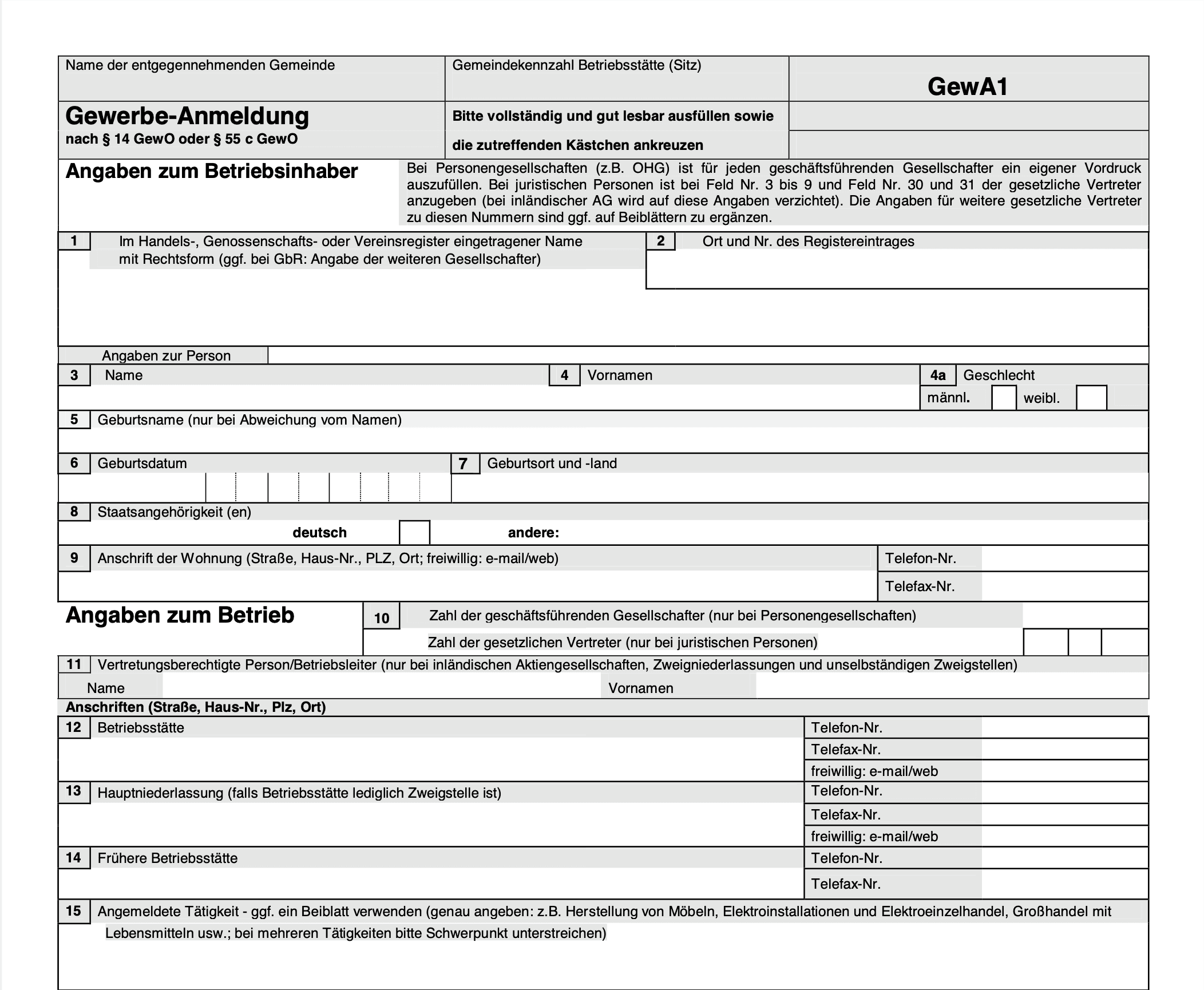
- Form: the standardised, nationwide GewA 1 — in person or online via the authority’s portal.
- Deadline: before your first transaction. Registering late can mean a fine of up to €1,000.
- Automatic after filing: the Finanzamt sends the tax registration questionnaire; the IHK/HWK and accident insurance fund get in touch.
What is the Gewerbeanmeldung?
The Gewerbeanmeldung (form GewA 1) is your formal notification to the local Gewerbeamt that you are starting an independent, ongoing, profit-oriented activity. The legal basis is § 14 of the German Trade Regulation Act (GewO). It is the precondition for trading as a business owner, getting a tax number from the Finanzamt and joining the relevant Chamber of Industry and Commerce (IHK) or Chamber of Crafts (HWK).
Important: not every self-employed activity is a Gewerbe. Liberal professions under § 18 EStG — doctors, lawyers, designers, consultants, programmers — are exempt from the trade registration and only register with the Finanzamt. Farmers and the pure management of your own assets are also exempt. See our guide on the Freiberufler vs. Gewerbetreibender distinction.
Who must register?
You need a Gewerbeanmeldung as soon as you:
- set up a sole proprietorship, GbR, OHG, KG, GmbH or UG and operate commercially
- act regularly and with the intent to make a profit
- are not a Freiberufler under § 18 EStG
Capital companies such as GmbH and UG also need a Gewerbeanmeldung in addition to their commercial register entry. The two procedures run in parallel — for a GmbH, the trade registration usually follows the notarial deed and the commercial register entry. See our guide on GmbH formation for the full timeline.
Whether you have to register at all depends solely on the nature of your activity:
| Activity | Register with the Gewerbeamt? | Examples |
|---|---|---|
| Commercial trade | Yes, GewA 1 | Retail, crafts, online shop, hospitality, service provider |
| Liberal profession (§ 18 EStG) | No, Finanzamt only | Doctor, lawyer, tax advisor, journalist, programmer, designer |
| Agriculture and forestry | No | Farmer, winegrower |
| Pure asset management | No | Letting your own property |
The line is not always clear-cut — for borderline activities (e.g. IT consulting that also sells products), the Finanzamt decides in case of doubt. We cover this in detail in Freiberufler vs. Gewerbetreibender.
Main business or sideline (Haupt- vs Nebengewerbe)?
On the form you tick whether you run the trade as a main or secondary occupation. There is no tax difference — the form and the fee are identical. The distinction mainly matters for your social insurance:
- Hauptgewerbe (main business): self-employment is your primary source of income. You arrange your own health, pension and, where applicable, long-term care insurance.
- Nebengewerbe (sideline): you are mainly employed or studying and run the trade on the side. To stay insured through your main job, the self-employed activity must generally not exceed around 20 hours per week or become your main source of income.
If you run a trade alongside a job, clarify it in advance with your employer and health insurer. How the two incomes interact for tax is explained in our guide Kleingewerbe vs. Kleinunternehmer.
Documents you need
- Valid ID card or passport (with a passport, also a registration certificate)
- For non-EU citizens: residence permit explicitly allowing self-employment
- Registration fee (cash or card on site)
- For regulated trades: extra permits (e.g. catering license, master craftsman card, brokerage permit under § 34c GewO)
- For legal entities: articles of association, commercial register extract, director appointment certificate
Step by step: registering your business
- Find the right Gewerbeamt. It is the office at your business address — in many cities part of the public order office (Ordnungsamt).
- Book an appointment or start the online filing. On-site waits can be two to six weeks; the online route is usually faster.
- Fill in form GewA 1. Describe your activity precisely — too narrow limits your business; too broad triggers extra permits.
- Submit documents and pay the fee. On site directly at the office; online via bank payment.
- Receive the Gewerbeschein. You’ll need the certificate for your bank, the IHK and your insurance — keep the original safe.
How much does it cost in 2026?
The registration fee at the trade office in 2026 ranges from €15 to €65 depending on state and city. Online filings are cheaper than the counter in many cities:
| City | In person | Online |
|---|---|---|
| Berlin | ~€26 | ~€15 |
| Hamburg | ~€20 | ~€20 |
| Munich | ~€60 | ~€47 |
| Frankfurt | ~€30 | ~€30 |
| Stuttgart | ~€57.50 | – |
The fee is fully deductible as a business expense. Depending on the trade, one-off costs for permits, a certificate of good conduct or an extract from the trade register may apply — but only for regulated activities.
Online Gewerbeanmeldung in 2026
Following the nationwide rollout in 2024–2025, registering online via the federal portal or your state’s portal is now possible in nearly all German states. You’ll need:
- An ID card with the online function (eID) activated, or an Elster certificate
- AusweisApp or compatible software
- Your eID PIN
Processing usually takes a few days and the certificate arrives as a PDF — no waiting at the counter. Conveniently, the online process notifies the Finanzamt, the IHK and the accident insurance fund directly, so the follow-up steps start automatically.
What happens after registration?
A whole chain of follow-up processes kicks off automatically. The trade office forwards your data, and the remaining bodies get in touch one after another:
- The Finanzamt sends you the tax registration questionnaire (Fragebogen). Filling it in is mandatory and produces your tax number and, if requested, your VAT ID.
- The IHK or HWK contacts you. Membership is mandatory; small businesses are usually fee-exempt below certain thresholds.
- The Berufsgenossenschaft (statutory accident insurance) is notified.
- After the first profit estimate you become liable for trade tax (Gewerbesteuer). For sole proprietors and partnerships there is a €24,500 allowance; for GmbH and UG it is owed from the first euro.
In the questionnaire you also decide whether to use the small-business scheme (Kleinunternehmerregelung) — it exempts you from VAT as long as your prior-year turnover stays below €25,000 and your current-year turnover below €100,000, but it excludes input-VAT deduction.
A rough timeline for the first few weeks:
| Timing | What to do |
|---|---|
| Day 0 | File the Gewerbeanmeldung (GewA 1), receive the Gewerbeschein |
| Week 1–2 | Open a business account, set up bookkeeping |
| Week 2–4 | Complete the tax registration questionnaire → tax number |
| Week 4–6 | Respond to mail from the IHK/HWK and accident insurance fund |
The starter book for your self-employment
Free e-book: registration, accounting, your first invoice, and taxes — plus a tax calendar, deductions cheat sheet, and invoice template.
GewA 1, GewA 2, GewA 3: registration, change, deregistration
The Gewerbeanmeldung is only one of three nationwide forms. Which one you need depends on what changes about your business:
- GewA 1 – registration: the start. New business, new business address or new activity.
- GewA 2 – change (Ummeldung): when something material changes — a move within the same municipality, a change or extension of the activity, a new partner.
- GewA 3 – deregistration (Abmeldung): when you close the business or move your business address to another municipality (where you then file a new GewA 1).
A change or deregistration usually costs a similar fee to the registration. They are mandatory too — forget the deregistration and you may keep paying IHK fees and stay on the tax register.
Common mistakes to avoid
Trading before registration. Even a single invoice issued before the registration can trigger a fine. Register first, sell second. The fine can be up to €1,000 (§ 146 GewO), and more for regulated trades.
Vague activity description. Be concrete — “management consulting”, not “services of all kinds”. Changes are possible later but cost a new fee.
Forgetting to update the address. Moving locations means a change (GewA 2) or deregistration and a new registration.
Missing a permit requirement. Some trades — security, brokerage, hospitality, regulated crafts — need an extra permit before registration.
Frequently asked questions
Which form do I need for a sideline business?
The same one as for a main business: the GewA 1. You simply tick that it is a secondary occupation. The fee is identical.
Can I register a business retroactively?
Yes. If you have already worked without registering, the trade office requires a retroactive registration from the actual start date. This is possible but can lead to a fine and tax back-payments — better to register too early than too late.
Do freelancers need a Gewerbeanmeldung?
No. Liberal professions under § 18 EStG register only with the Finanzamt via the tax registration questionnaire and pay no trade tax. What matters is the nature of the activity, not what you call yourself.
How long does the Gewerbeanmeldung take?
In person it is usually done in half an hour and you get the Gewerbeschein on the spot. Online, processing typically takes a few days, after which the certificate arrives as a PDF.
How much does it cost to deregister the business?
The deregistration (GewA 3) usually costs between €0 and €25 depending on the city, and is free in many municipalities. The key is not to forget it — otherwise fees and reporting duties keep running.
Do I need a separate business account?
For sole proprietors it is not a legal requirement, but strongly recommended to keep private and business finances apart. For GmbH and UG a dedicated business account is mandatory.
Conclusion
Most Gewerbeanmeldungen are done in half an hour, cost €15–65, and unlock the rest: tax registration questionnaire, tax number, IHK membership, bookkeeping setup. The single biggest mistake is starting business activity before filing the form — register before your first transaction.
Ironically, Norman itself missed the Gewerbeanmeldung and only filed after a letter from the Gewerbeamt. Don't be like us — don't miss the filing.
 Peter BoykoFounder of Norman
Norman walks with you from day one: from the becoming self-employed checklist to AI bookkeeping and tax filing — no separate accountant, all in one app.
Business registered — now what?
Right after the Gewerbeanmeldung come the tax registration questionnaire, your tax number and your first bookkeeping. Norman walks you through the questionnaire, sets up small-business or standard VAT status correctly, and then handles bookkeeping, invoices and your tax return — no separate accountant, all in one app.