
Estimated Tax Payments in Germany 2026: Dates, Calculation and Adjustment
Estimated tax payments 2026 for self-employed in Germany: quarterly income and trade tax dates, calculation with the EUR 12,348 basic allowance, and how to request a reduction.
- Category
- Taxes
- Updated
- Author
- Diana
If you are self-employed in Germany, you do not pay your income tax only with the annual return — you pay it quarterly, in advance. The tax office (Finanzamt) sets these estimated tax payments based on your most recent assessment, and if you run a trade business (Gewerbe), trade tax prepayments to your municipality come on top. Knowing the dates, understanding the amount, and filing a reduction request when income drops keeps you out of cash-flow trouble and avoids late-payment surcharges.
Key Points at a Glance
- Income tax dates 2026: 10 March, 10 June, 10 September, and 10 December — paid to the Finanzamt (§ 37 EStG).
- Trade tax dates 2026: 15 February, 15 May, 15 August, and 15 November — paid to the municipality (§ 19 GewStG). If a date falls on a weekend, it moves to the next business day.
- Calculation: The Finanzamt takes the income tax from your last assessment and divides it by four. The basic tax-free allowance for 2026 is EUR 12,348.
- When it applies: Prepayments are only set if they reach at least EUR 400 per year and EUR 100 per quarter.
- Reduction: If your profit drops, you can request a reduction at any time — informally or via ELSTER — with a BWA (business evaluation) or profit forecast as evidence.
- Grace period: Bank transfers have a 3-day grace period; after that, late-payment surcharges of 1 % per month apply.
What Are Estimated Tax Payments?
Estimated tax payments are quarterly advance instalments on your income tax (Einkommensteuer) and, for trade businesses, additionally on trade tax (Gewerbesteuer). The Finanzamt sets the amount based on your most recent income tax assessment (Einkommensteuerbescheid). This way, the state ensures you settle your tax across the year rather than all at once at year-end.
The system applies primarily to freelancers, sole traders, and partners in partnerships — because, unlike employees, no wage tax is withheld for them by an employer. The prepayment is therefore the mechanism the tax office uses to collect the ongoing income tax of the self-employed.
Important: estimated tax payments are not to be confused with the VAT return (Umsatzsteuervoranmeldung). While the prepayment concerns your income tax, the VAT return is the regular reporting and remittance of value-added tax to the Finanzamt.
Who Has to Make Prepayments?
Not every self-employed person automatically receives a prepayment notice. The Finanzamt only sets prepayments once they reach a minimum amount:
- At least EUR 400 per calendar year and at least EUR 100 per quarter (§ 37 (5) EStG). If your expected tax is below that, the Finanzamt waives prepayments — you then pay only with the annual return.
- The last assessment is the basis. As long as no income tax assessment exists yet — typical in your founding year — the Finanzamt often estimates your income from your tax registration questionnaire (Fragebogen zur steuerlichen Erfassung). It pays to make that estimate realistic.
- Employees with side income can also be affected, for example rental income or a part-time self-employment not covered by wage tax withholding.
Payment Dates 2026
Depending on your activity, you may need to track two separate prepayments: income tax to the Finanzamt and — for trade businesses — trade tax to your municipality. Both are due four times a year, but on different dates:
| Tax type | Dates 2026 | Paid to |
|---|---|---|
| Income tax prepayment | 10 March, 10 June, 10 September, 10 December | Finanzamt |
| Trade tax prepayment | 15 February, 15 May, 15 August, 15 November | Municipality / city treasury |
If a date falls on a Saturday, Sunday, or public holiday, the deadline shifts to the next business day. In 2026 this affects trade tax: 15 February and 15 November fall on a Sunday (pay by 16 February / 16 November), and 15 August on a Saturday (by 17 August). All income tax dates fall on business days in 2026.
For bank transfers there is also a 3-day grace period (Schonfrist): the payment must be credited to the Finanzamt's or municipality's account within three days of the due date. The safest option is a SEPA direct debit — the amount is then collected automatically and on time. For a full calendar of tax deadlines, see our tax calendar and the VAT deadlines 2026 overview.
How the Finanzamt Calculates the Amount
The amount of your prepayment is based on your last income tax assessment. The Finanzamt takes the income tax it set and divides it by four. To estimate your own 2026 liability, the key figures are:
- Basic allowance 2026: EUR 12,348 — no income tax is due up to this taxable income.
- Progressive rate: The entry rate is 14 %, the top rate of 42 % kicks in from around EUR 69,879, and from EUR 277,826 the so-called wealth tax rate of 45 % applies.
- Solidarity surcharge: Waived for most self-employed people. It only applies once your assessed income tax exceeds the exemption threshold of EUR 20,350 (single filers, 2026) — then at 5.5 %.
Worked Example
Suppose your last assessment shows, at a taxable income of EUR 60,000, an income tax of EUR 14,233 (average rate around 23.7 %). The Finanzamt divides this by four:
| Step | Amount |
|---|---|
| Taxable income | EUR 60,000 |
| Assessed income tax 2026 | EUR 14,233 |
| Solidarity surcharge (below EUR 20,350 threshold) | EUR 0 |
| ÷ 4 quarters | ≈ EUR 3,558 per quarter |
Because the assessed tax of EUR 14,233 is below the solidarity surcharge threshold, no surcharge applies in this example. The exact amount depends on your personal circumstances (special expenses, pension contributions, other income). If you run a trade business, trade tax prepayments come on top — see how this works for corporations in our guide to tax prepayments for GmbH and UG.
Setting aside around 30% of your revenue for taxes is a solid rule of thumb. You should of course adapt it to your business — software engineers should save closer to 35%, while e-commerce with thin margins can go below 10%. Interest-bearing accounts are a big help here.
 Peter BoykoFounder of Norman
Requesting a Reduction
If your income for the current year is significantly lower than the year underlying your last assessment, you can request a reduction of estimated tax payments (Herabsetzung der Vorauszahlungen). This is especially useful if you have just started out, lost a major client, or face seasonal swings. Here is how:
- Informal application: A simple letter with a justification to your local Finanzamt is enough.
- Via ELSTER: The request can also be filed electronically through the ELSTER portal.
- Attach evidence: Include a current business evaluation (BWA), a profit forecast, or other documents that make your lower income plausible.
- Timing: A reduction request is possible at any time — even retroactively, up to 15 months after the end of the calendar year (§ 37 (3) EStG). It is best filed in good time before the next due date so the adjustment takes effect immediately.
Note: if the Finanzamt reduces your prepayments but your actual income ends up higher, you will have to pay the difference with your tax return. A prepayment set too low only defers the burden — it does not make it disappear.
Can the Finanzamt Increase the Prepayment?
Yes. The Finanzamt may not only lower prepayments but also adjust them retroactively when it learns of higher income — likewise up to 15 months after the end of the calendar year. However, it only makes a retroactive increase if the additional amount reaches at least EUR 5,000 for the calendar year (§ 37 (3) EStG).
In practice this means: if your profit grows strongly, the next assessment may bring a notice that raises your prepayments and demands the past quarters in a single sum. Anyone expecting rising income should reserve for this from the start rather than be caught out by a back-payment.
What Happens If You Don't Pay?
Missing an estimated tax payment triggers the following consequences:
- Late-payment surcharge (Säumniszuschlag): 1 % of the outstanding amount for each commenced month of delay (rounded down to full EUR 50).
- Grace period: The 3-day grace period applies only to bank transfers. If the money arrives within that window, no surcharge is due.
- Enforcement measures: For persistent non-payment, the Finanzamt can attach bank accounts, garnish income, or take other enforcement action.
- Deferral as a way out: If you temporarily cannot pay, apply early for a deferral (Stundung). This often avoids enforcement.
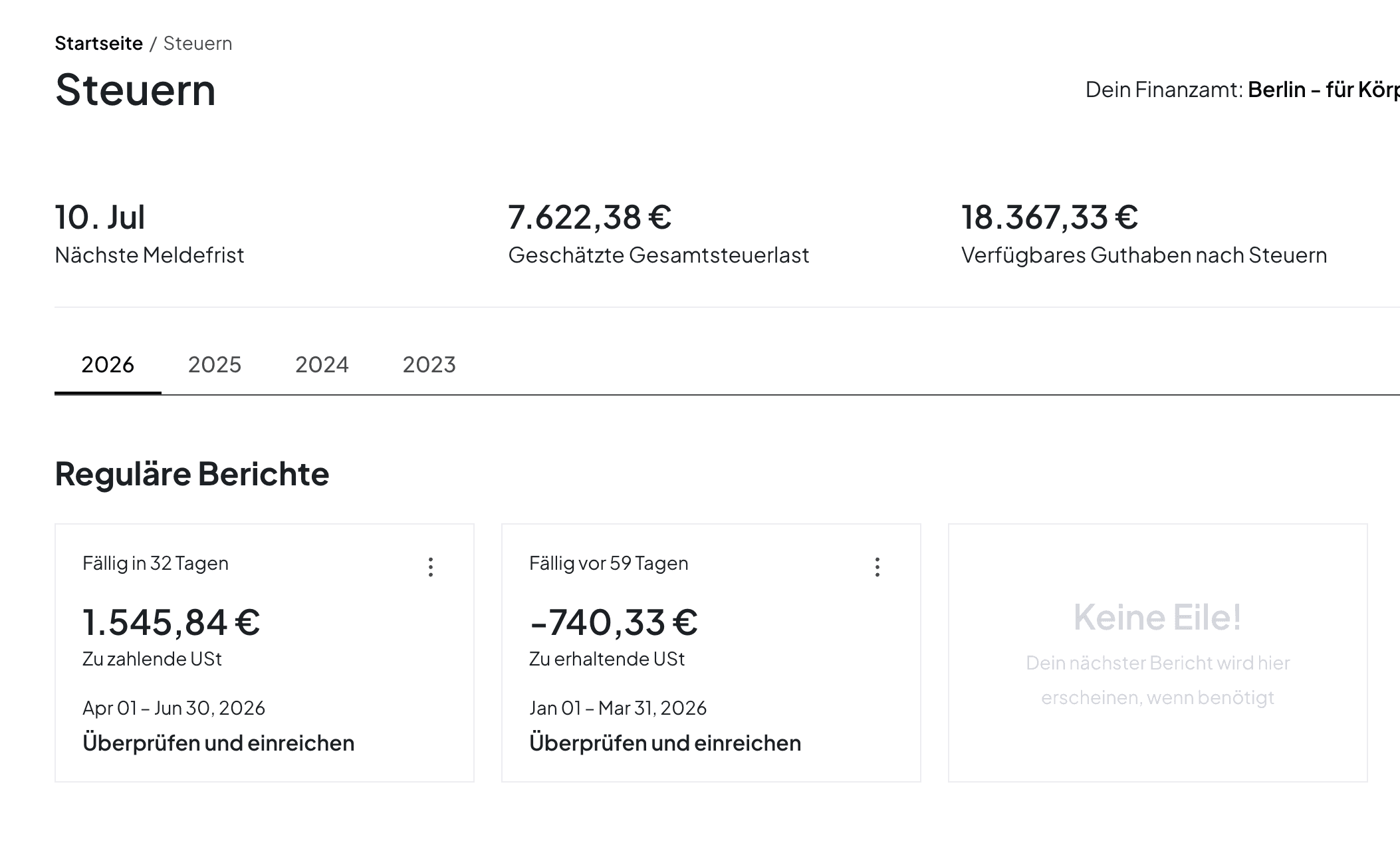
Tracking Tax Payments with Norman
Managing prepayments manually costs time and nerves. With Norman you keep a constant overview of your tax burden:
- Live tax calculation: Norman estimates your income tax in real time based on your current income and expenses.
- Reserve dashboard: The dashboard shows exactly how much you should set aside for upcoming prepayments — no more nasty surprises.
- Payment reminders: Norman reminds you in good time of the quarterly due dates, so you never miss a deadline and avoid surcharges.
Frequently Asked Questions on Estimated Tax 2026
How often can I request a reduction?
As often as your income situation requires. The Finanzamt expects a plausible justification with each request, however. With very frequent adjustments, it may ask for additional evidence.
What happens to overpaid prepayments?
If you have prepaid more over the year than your actual tax, the Finanzamt refunds the difference with your income tax assessment. The money is not lost — it just comes back after the assessment. That is why a reduction request is worthwhile when income drops, purely for cash-flow reasons.
Do I have to pay even if I have filed an objection?
Yes. An objection (Einspruch) against the prepayment notice has no suspensive effect. You must keep paying for now, unless the Finanzamt grants a suspension of enforcement (Aussetzung der Vollziehung) on request.
Does the basic allowance also apply to prepayments?
Yes. The basic allowance of EUR 12,348 (2026) is already built into the income tax tariff on which the prepayment is based. If your taxable income is below it, no income tax — and therefore no prepayment — is due.
Where do I find out how high my prepayment is?
The amount is stated in your prepayment notice (Vorauszahlungsbescheid), which the Finanzamt sends with or after the income tax assessment. With Norman you also see your expected tax burden on an ongoing basis, without waiting for the notice.
Conclusion
Estimated tax payments are among the most important tax obligations for the self-employed in Germany. Whoever knows the dates — 10 March, June, September, and December for income tax, 15 February, May, August, and November for trade tax — understands the calculation, and files a reduction request in time when needed, avoids unnecessary back-payments and surcharges.
Don't forget to keep an eye on your VAT return alongside the income tax prepayment — it is another regular reporting obligation that applies to most self-employed people.
How big will your next prepayment be? Norman already knows
Norman calculates your estimated tax burden in real time from your current income and expenses. You always see how much to set aside — no prepayment will catch you off guard again.