
EÜR Template 2026: Structure, Excel Sample and the Official Anlage EÜR
An EÜR template gives you the skeleton for your profit calculation — from operating income down to input VAT. Here is the line-by-line structure, the difference between a free Excel template and the official Anlage EÜR, and who must use which.
- Category
- Business
- Updated
- Author
- Diana
An EÜR template removes the hardest decision: it tells you which lines exist in the first place. Instead of staring at a blank sheet, you drop your fees, rent and depreciation into ready-made categories — and the profit almost works itself out at the bottom. For how the EÜR works in detail, see the full EÜR guide; this article is about the template itself: its structure, the free Excel version, and the official form.
Key takeaways
- Two templates, two purposes: The free Excel/Google Sheets template is your working sheet through the year. The official Anlage EÜR is the mandatory form you submit electronically via ELSTER at year-end.
- The structure is always the same: operating income at the top, operating expenses below, and at the bottom profit = income − expenses (§ 4 (3) EStG).
- A template does not replace ELSTER. However tidy your spreadsheet, you still have to file the Anlage EÜR digitally through ELSTER. The template is only preparation.
- Mandatory for everyone, no allowance: The old €17,500 limit for an informal EÜR was scrapped in 2017. Today everyone must use the official Anlage EÜR — including small businesses (Kleinunternehmer).
- Gross or net? The most common template mistake: VAT and input VAT belong in their own lines, not blended into the amounts. Small businesses calculate everything gross.
What is an EÜR template?
An EÜR template is a ready-made grid for your profit calculation. It lists every relevant income and expense category, so all you do is enter amounts. Keep two forms apart:
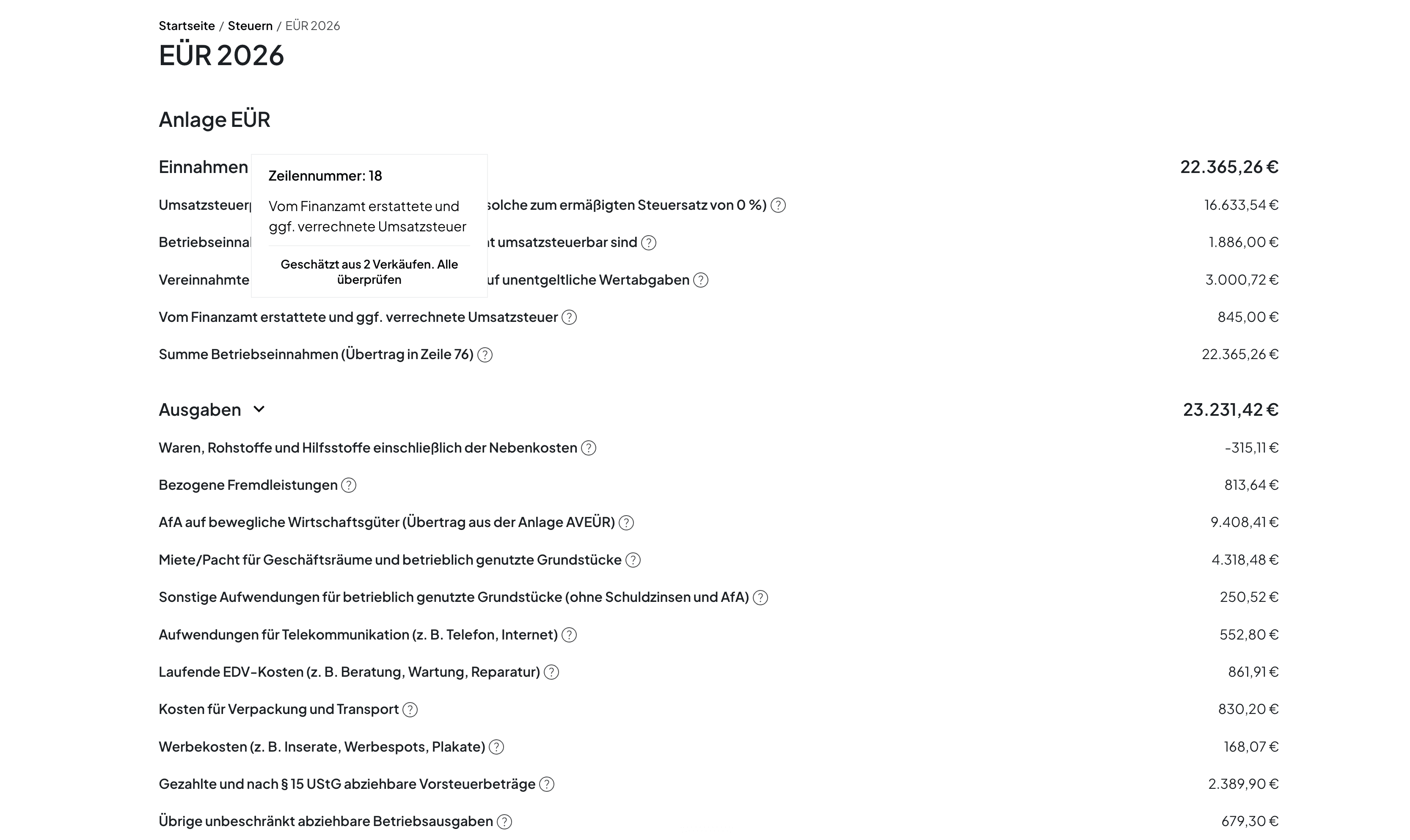
1. The official Anlage EÜR. This is the tax authority's official form. It has fixed, numbered lines (e.g. "Line 11: revenue", "Line 60: input VAT paid") and is submitted only electronically via ELSTER or compatible software — paper is allowed in hardship cases only. You cannot redesign this template; its layout is fixed.
2. The free working template (Excel, Google Sheets, PDF). This is your own collection sheet for recording income and expenses through the year. It mirrors the official categories, but you design it yourself. At year-end you carry the totals into the Anlage EÜR. Such an Excel template is not a substitute for ELSTER — it is the step before it.
The good news: both follow the same structure. Once you understand the skeleton, you can find your way around any template.
The structure of an EÜR template: line by line
Every EÜR — official or Excel — has three blocks: operating income, operating expenses, profit. Here is the skeleton the Anlage EÜR is built on too:
| Block | Line / category | What goes here |
|---|---|---|
| Operating income | Revenue (Umsatzerlöse) | Fees, invoiced amounts, sales — net if you are VAT-registered |
| VAT received | The VAT your customers paid you (own line, never blended into revenue) | |
| VAT refunded by the tax office | Input-VAT refunds that hit your account | |
| Private car use & withdrawals | Withdrawals: privately used company car, goods taken out | |
| Other income | Interest, asset sales, released reserves | |
| Operating expenses | Goods & external services | Purchased goods, materials, bought-in services |
| Staff costs | Wages, salaries, social contributions for employees | |
| Premises costs | Business rent, utilities, the home office share | |
| Depreciation (AfA) | Proportional cost of purchases over €800 net, spread over the useful life | |
| Low-value assets (GWG) | Purchases up to €800 net, fully deductible at once | |
| Vehicle costs | Fuel, insurance, repairs — or the per-kilometre flat rate | |
| Travel & advertising | Travel costs, per-diem allowances, marketing | |
| Other costs | Phone, internet, office supplies, insurance, software, advice | |
| Input VAT paid | The VAT from your incoming invoices (own line) | |
| VAT paid to the tax office | Your VAT advance payments | |
| Result | Profit / loss | Operating income − operating expenses — the basis for your income tax |
That is the core of every EÜR template. Rebuild this structure in Excel or download a ready-made template, and you have the skeleton you only have to carry into ELSTER at year-end.
Free EÜR template (Google Sheets)
Enter income and expenses — profit and the official Anlage EÜR lines are calculated automatically.
Excel template vs. accounting software
A free Excel or Google Sheets template is a fine starting point — as long as your business stays simple. But once VAT, depreciation and dozens of receipts a month enter the picture, the spreadsheet becomes error-prone. The comparison:
| Excel/Sheets template | Accounting software | |
|---|---|---|
| Cost | Free | Often free to low-cost |
| Upkeep | Manual, every entry by hand | Scan receipts, automatic sorting |
| VAT & input VAT | Calculate yourself, error-prone | Automatic by tax rate |
| Depreciation | Needs a separate sheet | Carried automatically |
| ELSTER filing | Re-type manually | Direct submission |
| GoBD-compliant | Only with discipline (file is editable) | Yes, audit-proof |
Rule of thumb: a template is enough if you have few receipts a year and work as a small business without VAT. Once you are on standard taxation or invest regularly, tools save you the manual maths — and the risk of forgetting a line. For the options, see the EÜR software comparison.
When calculating the EÜR yourself, the biggest issue we see is brutto/netto mishaps. They are hard to track in Excel and easy to wrongly file in the tax return.
 Peter BoykoFounder of Norman
Who must use the official Anlage EÜR?
A lot of outdated information circulates here. The key points for 2026:
- There is no more allowance threshold. Until tax year 2016 you could file an informal EÜR on a single sheet of paper if your operating income was below €17,500. That simplification was scrapped in 2017: today everyone must submit the official Anlage EÜR electronically via ELSTER — whether your turnover is €500 or €500,000.
- The EÜR itself is allowed as long as you stay small. You may use the EÜR (instead of a balance sheet) as a freelancer with no turnover limit, and as a trader up to €800,000 turnover and €80,000 profit per year (§ 141 AO). Above that you become liable to do double-entry bookkeeping — see how the switch to a balance sheet works.
- Small businesses must file an EÜR too. The VAT exemption under § 19 UStG does not release you from calculating profit. Your template is just simpler: no VAT received, no input VAT — you work entirely with gross amounts.
Outdated figures such as "€60,000 profit" or "€600,000 turnover" that some template providers still quote no longer apply since 2024. The binding limits are €800,000 / €80,000.
Common mistakes when filling in the template
Even the best template won't save you from the classics:
- Mixing gross and net. If you are VAT-registered, net revenue and VAT received belong in separate lines. Putting gross amounts into revenue distorts the profit.
- Forgetting depreciation. A €1,500 net laptop does not belong fully in the year of purchase, but in the depreciation line, spread over its useful life.
- Not stripping out private shares. For a company car or a partly private phone, you must record the private share as a withdrawal — otherwise you deduct too much.
These and other traps — from the wrong cash-flow year to a missed loss carry-forward — we walk through in detail in the guide to the ten most common EÜR mistakes.
Frequently asked questions about the EÜR template
Is an Excel template for the EÜR accepted by the tax office?
Yes. You may work with any template through the year — Excel, Google Sheets, paper. What matters is that your records are GoBD-compliant (unalterable, traceable) and that you carry the totals correctly into the official Anlage EÜR via ELSTER at year-end. You do not submit the Excel file itself to the tax office.
Where do I get the official Anlage EÜR?
You find the official form in your ELSTER account under "All forms → Income tax → Anlage EÜR". There you fill in the numbered lines and submit directly. The Federal Ministry of Finance publishes a PDF preview of the form each year, but you can only file electronically.
Do small businesses have to fill in an EÜR template?
Yes. Even as a small business under § 19 UStG you must file an EÜR and calculate your profit. Your template is just leaner: since you do not charge VAT, the lines for VAT received and input VAT disappear — you work entirely with gross amounts.
Gross or net — how do I enter the amounts?
If you are VAT-registered, you enter income and expenses net and keep VAT and input VAT in their own lines. As a small business you enter everything gross, because no VAT applies to you.
Is a free template enough or do I need software?
For a few receipts a year and no VAT, a free template is enough. Once VAT, depreciation and many receipts are involved, the manual spreadsheet becomes error-prone — then accounting software saves time and prevents forgotten lines. A comparison is in the EÜR software guide.
When is the EÜR for 2025 due?
You must file the Anlage EÜR for tax year 2025 via ELSTER by 31 July 2026 without a tax advisor, or by the end of February 2027 with one. It is part of your income tax return.
Conclusion
An EÜR template is the skeleton that explains profit calculation to you: income at the top, expenses below, profit at the bottom. The free Excel version helps with collecting, the official form with filing — and both follow the same structure. Book into the right lines through the year, and July is no longer a big project. Norman builds your EÜR automatically: scan receipts, categorise transactions, send the Anlage EÜR straight to ELSTER — without ever maintaining an Excel line by hand again.
From a template to an EÜR that fills itself in
A spreadsheet template means a year of manual upkeep. Norman sorts every transaction into the right EÜR line automatically, handles input VAT and depreciation, and produces the finished Anlage EÜR for ELSTER — bookkeeping is free, forever.