
Business Account for Freelancers in Germany 2026: Obligation, Personal Account and Comparison
Do freelancers need a business account? Legally no — but there are good reasons for one. We cover the obligation, the terms-of-service risk of a personal account, the tax benefits and the best free accounts.
- Category
- Business
- Updated
- Author
- Diana
In Brief: The Business Account for Freelancers
- Mandatory? No. Freelancers and sole traders don't have to keep a business account — the tax office doesn't require it.
- But: Most banks prohibit business use of personal current accounts in their terms and can close the account.
- Recommended: clean separation, a simple EÜR, a professional image — and account fees are deductible.
- Free options exist: Several providers offer the account free for freelancers.
- Tax: With a dedicated account, the EÜR and VAT return become far simpler.
Is a Business Account Mandatory for Freelancers?
No. As a freelancer in Germany you are not legally required to keep a separate business account. The same goes for sole traders and a GbR — the tax office does not object to business bookings running through a personal account.
The difference from a GmbH and UG: corporations must have a business account, because they are legal entities and have to demonstrably deposit share capital (§ 7 (2) GmbHG). Freelancers don't face that hurdle — the choice is yours.
The honest answer, though, is that "not mandatory" doesn't mean "not a good idea". In practice almost every argument favours a dedicated account — just for banking-law, tax and practical reasons rather than a legal obligation.
Using a Personal Account for Business — the Terms-of-Service Trap
Even though the tax office doesn't mind: most banks prohibit using a personal current account for business in their terms and conditions. If the bank notices heavy business traffic — many incoming invoices, customer payments, platform payouts — it can:
- demand a switch to a (pricier) business account,
- or, in extreme cases, close the account.
That's not a theoretical risk: especially as revenue grows, an account closure mid-operation is a real problem — customers have to be redirected, direct debits reset. A business account cleanly separated from the start removes that risk.
Why a Business Account Pays Off Anyway
Four reasons experienced freelancers almost always keep a dedicated account:
- Clean separation: Business and private are clearly split — the basis for correct bookkeeping.
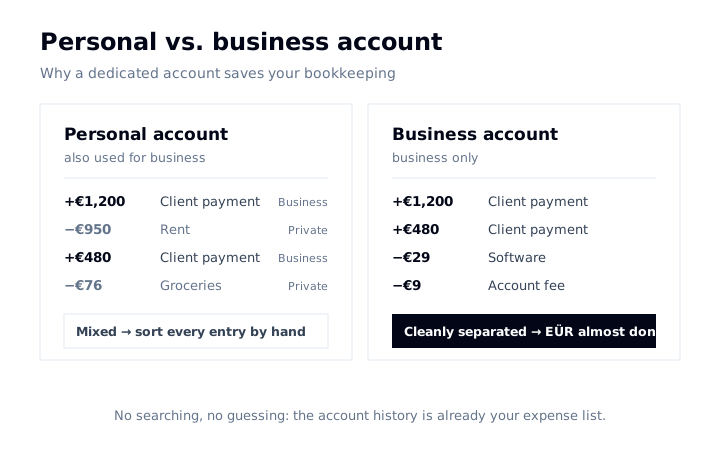
- Simple EÜR: At year-end you don't have to sort each booking into private/business. The account is already your list of business expenses.
- VAT under control: Collected and paid VAT can be traced per booking — the VAT return becomes a formality.
- Professional image: Payments from an account in your business's name look more credible than from a personal "Max Mustermann" account.
On top of that: account fees are fully deductible as a business expense, whereas with a mixed personal account you can hardly delineate a clean share.
The starter book for your self-employment
Free e-book: registration, accounting, your first invoice, and taxes — plus a tax calendar, deductions cheat sheet, and invoice template.
Please don't use your personal account — it creates a mess in your accounting and in your head. Find a free option and open a dedicated account for your business.
 Peter BoykoFounder of Norman
The Right Account for Freelancers — What to Look For
As a freelancer you're often responsible for everything — from the quote to the bookkeeping. The account should accordingly be mobile, simple and cheap. These points matter:
- Free or cheap plan: At low volume a free account is entirely enough.
- German IBAN: Some customers and direct-debit schemes prefer a DE IBAN.
- Bookkeeping connection: An open-banking interface or DATEV export so the EÜR runs automatically.
- App & invoicing: Receipt capture and sometimes built-in invoicing save a second tool.
- Few fixed costs: Look for free bookings instead of a high monthly fee.
Free Business Accounts for Freelancers 2026
For freelancers and sole traders there are several free or very cheap accounts:
| Provider | Monthly fee (from) | Strength for freelancers |
|---|---|---|
| Finom | €0/month | Free Solo plan, German IBAN, invoicing |
| Qonto | €0/month (Solo) | DATEV export, receipt capture, 3 months free for Norman users |
| N26 Business | €0/month | Simple app, 0.1% cashback |
| Vivid Business | €0/month | Cashback, multi-currency |
| FYRST | €0/month | German IBAN, cash handling |
| DKB | €0/month | Solid direct bank with a business account |
Qonto offers sole traders and freelancers a free starter plan with a German IBAN, DATEV export and automated receipt capture. Through our partner link there are 3 months of Qonto free. If you need more features, you move up to a higher plan later seamlessly.
Business Account and Tax: EÜR, VAT, Deductible Expense
This is where the dedicated account pays off most clearly. As a freelancer you determine your profit via the income-surplus calculation (EÜR) — a simple comparison of income and expenses. If everything runs through a business account, the account history is practically your EÜR basis already.
Three tax effects:
- EÜR: Every business expense is documented as an account movement — no searching, no estimating.
- VAT: Unless you use the small-business rule (Kleinunternehmerregelung), you charge VAT and deduct input tax. Traceable per booking, the return becomes easy.
- Deductible expense: The account fees themselves are deductible.
With accounting software that accesses the account via open banking, manual entry disappears almost entirely. More on this in Taxes for Freelancers 2026.
Small Business (Kleinunternehmer): Do I Need a Business Account?
As a small business under § 19 UStG the same applies: no obligation, but the same benefits. You don't charge VAT and skip the VAT return, yet the clean separation and the simple EÜR are just as valuable — and the terms-of-service risk of a personal account remains. Precisely because many small businesses start as a side hustle, a dedicated account pays off to keep employment and self-employment from blending. More on the rule: Kleinunternehmer VAT exemption 2026.
Frequently Asked Questions
Is a business account mandatory for freelancers?
No. Freelancers, sole traders and a GbR are not legally required to keep a business account. Only corporations like a UG and GmbH must have one.
As a freelancer, may I use my personal account?
Legally yes — the tax office doesn't object. But most banks prohibit business use in their terms and can demand a switch or close the account.
Are there free business accounts for freelancers?
Yes, several. Providers like Finom, Qonto (Solo), N26 Business or DKB offer the account free for sole traders and freelancers.
When does a business account pay off?
As soon as you regularly receive business payments or are liable for VAT. By then at the latest, the benefits of separation, the EÜR and terms-of-service safety clearly outweigh the cost.
Are the account fees deductible?
Yes. Fees for a business account are business expenses and reduce your profit. With a mixed personal account the deduction is hardly possible cleanly.
Conclusion
For freelancers a business account isn't mandatory — but it's almost always the smarter choice. It protects against the terms-of-service risk of a personal account, makes the EÜR and VAT simple, and looks more professional, while the fees stay deductible. Since free accounts exist, the hurdle is low. Pick an account with a good bookkeeping connection and link it directly to your software. Read on: Opening a Business Account 2026 · Opening a GmbH Business Account · EÜR for the Self-Employed 2026
Connect the account, the EÜR almost writes itself
Norman connects to your business account via open banking, imports every booking automatically and assigns it to your EÜR — including VAT detection and a running estimate of your tax bill. Invoicing and bookkeeping are free for the self-employed, and the EÜR and VAT return run from the same data. Bookkeeping comes down to barely more than a click.