
Business Bank Account in Germany 2026: Who Needs One, Comparison and Costs
Who needs a business account and who doesn’t? We explain the obligation by legal form, the difference from a personal account, what to look for, and which banks lead in 2026.
- Category
- Business
- Updated
- Author
- Diana
In Brief: The Business Account at a Glance
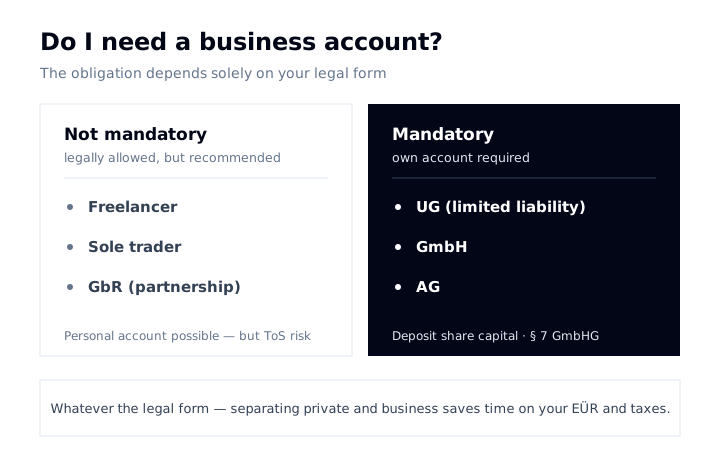
- Obligation by legal form: A business account is mandatory for a UG, GmbH and AG. For freelancers, sole traders and a GbR there is no legal obligation.
- Personal account instead? Legally allowed for the self-employed — but most banks exclude business use in their terms and can close the account.
- Recommended almost always: clean separation, simple bookkeeping, a professional image — and account fees are deductible as a business expense.
- Costs: neobanks from €0–9/month, opening in 1–5 days; traditional banks €12–30/month.
- After opening: connect the account to your bookkeeping — via open banking, transactions flow automatically into your EÜR or double-entry books.
What Is a Business Account — and How Does It Differ From a Personal Account?
A business account is a payment account through which only business income and expenses flow. Technically it works like a current account, but legally and for tax purposes it is clearly separate. Two differences matter:
- The bank's terms: Personal current accounts are almost always reserved for private use in the terms and conditions. Using them for business breaches those terms.
- Retention & transparency: Different obligations apply to business accounts — for example a ten-year retention period for account records. Personal accounts, in turn, get more consumer protection.
The real value, though, lies in the separation: if business and private payments share one account, every entry becomes detective work — and the tax office looks more closely during an audit.
Who Needs a Business Account? Obligation by Legal Form
Whether a business account is mandatory depends solely on your legal form:
| Legal form | Account mandatory? | Reason |
|---|---|---|
| Freelancer | No | No legal obligation, but strongly recommended |
| Sole trader | No | Like a freelancer — optional but sensible |
| GbR (partnership) | No | Not required; with several partners, separation is still advisable |
| UG (haftungsbeschränkt) | Yes | Corporation — share capital must be deposited |
| GmbH | Yes | § 7 (2) GmbHG: share capital paid in before registration |
| AG | Yes | Like a GmbH — the legal entity's own account is mandatory |
In short: corporations (UG, GmbH, AG) must have their own account, because they are legal entities and have to demonstrably deposit share capital. How this works for a GmbH is covered in detail in Opening a GmbH Business Account.
For freelancers, sole traders and a GbR there is no obligation — the tax office does not require a business account. Why one almost always pays off anyway is covered in Business Account for Freelancers.
Using a Personal Account for Business — Allowed, but Risky
As a freelancer or sole trader you may legally use your personal account for business too — the tax office does not object. The catch is the bank: most institutions exclude business use of personal current accounts in their terms. If the bank notices heavy business traffic, it can demand a switch to a business account or, in extreme cases, close the account.
There's also the practical effort: with a mixed account you have to assign every single transaction as private or business at year-end. A separate account spares you that — and makes your bookkeeping audit-proof.
For my business and myself I usually keep around three accounts: one operational main account, typically at a neobank; one reserve account at an older bank with a full license; and one account for special needs, like good FX or higher interest rates.
 Peter BoykoFounder of Norman
What to Look for When Choosing
Not every business account fits every operation. These five criteria decide:
- Legal-form support: Not every neobank opens accounts for every legal form. Before applying, check that yours (freelancer, GbR, UG, GmbH) is supported.
- Cash: If you regularly deposit or withdraw cash, watch for favourable ATM terms — the strength of traditional branch banks.
- Transaction volume & booking fees: Many transfers? Then the number of free bookings matters more than the monthly fee.
- Cards & team access: Several partners or employees need their own cards and permissions — especially in a GbR or GmbH.
- Bookkeeping connection: A clean DATEV export or a direct open-banking interface saves hours of retyping later.
Opening a Business Account: Process and Documents
At neobanks the process is fully digital and takes 1–5 business days depending on the legal form; at traditional banks it takes longer. You usually need:
- ID document (passport or national ID)
- Tax number or business identification number
- For a trade: trade registration (how to)
- For a GbR/corporation: articles of association and, if applicable, a commercial register extract
Identity verification runs via video ident in a few minutes. Once you receive the IBAN and login details, the account is ready to use.
Providers Compared 2026
For most of the self-employed and small businesses, neobanks are the faster and cheaper choice. The main providers:
| Provider | Monthly fee (from) | Opening | Best for |
|---|---|---|---|
| Qonto | €9/month (Solo free) | 1–2 days | Scaling businesses, UG/GmbH, DATEV export |
| Finom | €0/month | Minutes–1 day | Freelancers & small businesses, German IBAN |
| N26 Business | €0/month | 1–3 days | Solo self-employed, simple app |
| Vivid Business | €0/month | 1–2 days | International revenue, cashback |
| FYRST | €0/month | A few days | Cash users, Deutsche Bank network |
| Traditional bank | €12–30/month | 1–4 weeks | Advice, credit lines, cash |
Qonto is the market leader for digital business accounts: German IBAN, DATEV export, automated receipt capture and Mastercard cards with spending limits. Norman customers get 3 months of Qonto free through our partner link. For sole traders and freelancers there is a free starter plan.
What Does a Business Account Cost?
Business accounts are on average somewhat pricier than personal accounts, but the range is wide:
- Monthly fee: €0–30. Neobanks often with a free starter plan; traditional banks usually from €12.
- Bookings: €0–0.50 per transaction; many plans include a quota of free bookings.
- Cards & cash: debit card usually included; cash deposits may cost extra.
Good to know: all account fees are business expenses and therefore fully deductible. A lean self-employment usually gets by on a free or cheap plan; with a team, cash or high volume a higher plan pays off.
The Business Account in Your Bookkeeping
The real time saving comes after opening — when the account talks directly to your bookkeeping. Modern tools like Norman connect to your business account via open banking, import every movement automatically, detect VAT and assign bookings to your EÜR or double-entry books. That saves hours each month and keeps your records GoBD-compliant — whether you file an EÜR as a freelancer or prepare a balance sheet as a GmbH.
Frequently Asked Questions
Is a business account mandatory?
It depends on the legal form. For a UG, GmbH and AG it is legally required. For freelancers, sole traders and a GbR there is no obligation — but a separate account is strongly recommended.
As a self-employed person, may I use my personal account for business?
Legally yes, the tax office does not object. But most banks prohibit business use of personal current accounts in their terms and can demand a switch to a business account or close it.
How long does opening an account take?
At neobanks usually 1–5 business days, often within a day via video ident. Traditional banks take one to four weeks, frequently with an in-branch appointment.
Are there free business accounts?
Yes. Several providers offer free starter plans, especially for sole traders and freelancers. For low transaction volume that's often enough.
Are account fees tax-deductible?
Yes. Fees for a business account are business expenses and reduce your profit. With a mixed-use personal account the deduction is hard to delineate cleanly.
Conclusion
A business account is only mandatory for corporations — for everyone else it's optional, but almost always the better choice. It separates private and business, makes bookkeeping audit-proof, and the fees are deductible. Pick an account that supports your legal form and connects to your bookkeeping, and link it to your software from day one. Read on: Business Account for Freelancers · Opening a GmbH Business Account · Taxes for Freelancers 2026
Business account and bookkeeping — from one place
Norman connects to your business account via open banking, imports transactions automatically, detects VAT and categorises every booking in real time. Invoicing and bookkeeping are free, and your tax return runs from the same data. The right account becomes bookkeeping that practically runs itself.