
UG or GmbH 2026: Differences, Costs and Which Legal Form Fits
UG or GmbH? Both have limited liability and pay the same taxes – what differs is share capital, the reserve obligation and credibility. We compare both legal forms point by point and show when each one pays off.
- Category
- Founding
- Updated
- Author
- Diana
In Brief: UG or GmbH?
- In common: Both are corporations, liable only with the company's assets, both need a notary, double-entry bookkeeping and a balance sheet – and pay the same taxes (corporate, trade tax, solidarity surcharge).
- The main difference: share capital. The UG starts from €1, the GmbH needs €25,000 (of which at least €12,500 at registration).
- The price for that: the UG must retain 25% of its annual profit as a reserve until it reaches €25,000. The GmbH has no reserve obligation.
- Credibility: the GmbH is seen as more reputable; the UG ("mini-GmbH") signals higher risk through its low capital.
- Rule of thumb: UG when the capital is missing or you want to test a model. GmbH when you can raise the €25,000 and need maximum credibility from the start.
UG and GmbH Compared Directly
The two legal forms are more closely related than many think: under § 5a GmbHG, the UG (haftungsbeschränkt) is merely a special form of the GmbH. Legally, almost all the same rules apply. The real differences fit into one table:
| Criterion | UG (haftungsbeschränkt) | GmbH |
|---|---|---|
| Minimum share capital | from €1 | €25,000 (at least €12,500 at registration) |
| Reserve obligation | 25% of annual profit up to €25,000 | none |
| Liability | limited to company assets | limited to company assets |
| Formation costs | from approx. €300 (model protocol) | approx. €800–2,500 |
| Notary required | yes | yes |
| Bookkeeping | double-entry, balance sheet | double-entry, balance sheet |
| Taxes | corp. tax 15% + soli + trade tax | corp. tax 15% + soli + trade tax |
| Outward image | "mini-GmbH", lower credit standing | high reputation |
| Company name | suffix "UG (haftungsbeschränkt)" | suffix "GmbH" |
| Profit distribution | only after 25% reserve | fully possible |
As the table shows, most rows are identical. Only three points really matter – share capital, the reserve obligation and credibility. Let's look at those more closely.
Share Capital: The Biggest Difference
Share capital is the central dividing line. For a GmbH you need at least €25,000, of which at least half – €12,500 – must actually be paid in at commercial register registration (§ 7 (2) GmbHG). Important: this money is not "gone". After registration it is fully available to the GmbH for rent, purchasing, salaries and investments.
The UG (haftungsbeschränkt) was created in 2008 for exactly those who cannot or do not want to raise that sum. In theory €1 of share capital is enough. In practice, €500 to €1,000 is sensible so the company doesn't slide into over-indebtedness from the first notary and formation costs alone.
In both cases the capital must be paid into a business account in the company's name – as a corporation, a dedicated account is mandatory. How that works is covered in Opening a GmbH Business Account.
The myth I often hear is that you need to come up with €25,000 and freeze it. That's not true — the first deposit can be just €12,500, and you can spend it on business expenses and investments right away. That changes the whole conversation: many more businesses should just start as a GmbH right away.
 Peter BoykoFounder of Norman
The Reserve Obligation: The Price of a Cheap Start
The UG's low share capital comes with a catch many overlook: the retention obligation under § 5a (3) GmbHG. The UG must retain 25% of its annual surplus each year as a statutory reserve. You may not distribute this money to yourself – it stays in the company until share capital and reserves together reach €25,000.
Only then is the UG "full", and you can convert it into a GmbH. A GmbH has no such obligation: it starts with the €25,000 already and may distribute its profits in full from the outset.
In practice: the UG is cheaper to start but slower to pay out. Anyone who wants to keep profits in the company anyway will barely feel the reserve obligation. Anyone who wants to distribute in full from day one is better served by the GmbH.
Formation Costs Compared
Beyond capital, the pure formation costs differ too – mainly through the notary fees, which scale with the share capital:
| Item | UG (model protocol) | GmbH |
|---|---|---|
| Notary (certification + registration) | approx. €100–300 | approx. €600–2,000 |
| Commercial register entry | approx. €150–200 | approx. €150 |
| Trade registration | €15–60 | €20–60 |
| Total formation costs | from approx. €300 | approx. €800–2,500 |
| Capital to be paid in | from €1 (€500–1,000 recommended) | at least €12,500 |
The model protocol (Musterprotokoll, for up to three shareholders and one managing director) lowers the notary costs for both forms. But the big item remains the capital: for the GmbH you need at least €12,500 in cash on top of the fees. That is exactly what makes the UG so attractive for tight budgets. Step-by-step guides are in How to Found a UG and How to Found a GmbH.
Liability, Taxes and Bookkeeping: Here UG and GmbH Are Identical
Once the company is set up, the differences almost vanish. On these points the law treats UG and GmbH exactly the same:
- Liability: Both are liable only with the company's assets (§ 13 (2) GmbHG). Your private assets stay protected – as long as you, as managing director, don't breach your duties.
- Bookkeeping: Both must keep double-entry books under the HGB, prepare annual accounts (balance sheet + P&L) and disclose them in the Federal Gazette. A simple EÜR is not enough for either.
- Taxes: Both pay corporate tax (15%) plus the solidarity surcharge and trade tax depending on the municipal rate. Details in Trade Tax for GmbH and UG.
This is the most important – and most underestimated – point: the UG is not "bookkeeping light". From day one the same obligations apply as for a GmbH. For many founders the real effort lies here, not in the share capital.
Converting a UG into a GmbH
The UG is designed as an entry point – the switch to a GmbH is built in. Strictly speaking it isn't a "conversion" under the Transformation Act, but a capital increase to €25,000 followed by a change of the legal-form suffix. The company stays the same – only "UG (haftungsbeschränkt)" becomes "GmbH".
Here's how it works:
- Raise the capital to €25,000 – from accumulated reserves, from profit, or through fresh contributions by the shareholders.
- Shareholder resolution on the capital increase and the renaming.
- Notarial certification of the resolution.
- Entry in the commercial register – from now on the company trades as a GmbH.
Two things matter: there is no legal obligation to convert the UG once it reaches €25,000 – you can remain a UG indefinitely. And after the capital increase the reserve obligation falls away, so you may distribute profits in full again.
When the UG Pays Off, and When the GmbH
The decision comes down to a few clear questions – not to gut feeling.
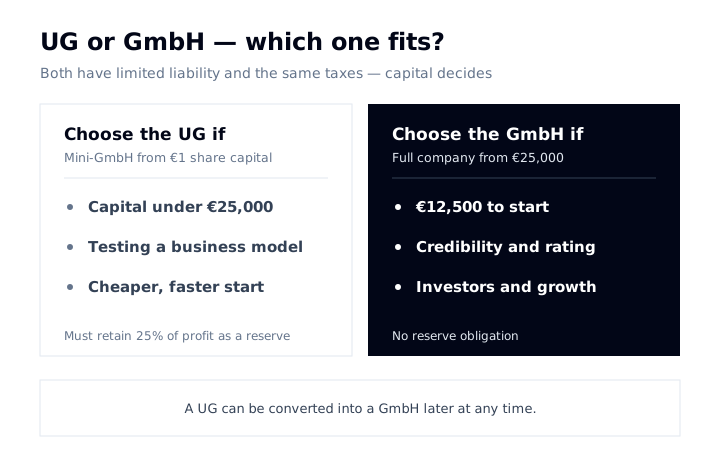
The UG fits when:
- you don't (yet) have the share capital for a GmbH,
- you want to test a business model cheaply first,
- you start as a solo founder with manageable risk,
- you reinvest profits in the company anyway – then the reserve obligation barely matters.
The GmbH fits when:
- you can raise the €25,000 (or €12,500 at formation),
- you need maximum credibility with banks, investors and large clients from the start,
- you plan equity stakes, loans or a later sale,
- you want to distribute your profits in full from the beginning.
When in doubt: both are fully fledged corporations. The UG is the cheaper entry with a built-in upgrade path; the GmbH is the standard choice as soon as capital and credibility matter more than a low start.
Frequently Asked Questions
Is the UG worse than the GmbH?
No. The UG is a full corporation with the same limited liability and the same obligations as a GmbH. It only has lower share capital and the reserve obligation – and therefore a somewhat weaker outward image.
Can I convert a UG into a GmbH later?
Yes. Once share capital and reserves reach €25,000, you can raise the capital to €25,000 by shareholder resolution and notarial certification and rename the company as a GmbH. But there is no obligation to do so.
Do UG and GmbH pay the same taxes?
Yes. Both pay corporate tax (15%), the solidarity surcharge and trade tax. There is no tax difference between UG and GmbH – only the UG's profit distribution is limited by the reserve obligation until it reaches €25,000.
Do I also have to pay in €12,500 for a UG?
No. The €12,500 (half the minimum capital) is a GmbH requirement. The UG can be founded from €1 – though here the entire share capital must be paid in immediately and in full.
Is a UG credible enough for clients and banks?
For many business models, yes. With larger contracts, loans or investor talks, however, the low capital can be read as a risk – the GmbH looks more credible here. Solid bookkeeping and proper annual accounts partly offset this.
Conclusion
UG or GmbH is mainly a question of capital. Both protect your private assets, both pay the same taxes and run the same double-entry bookkeeping. The UG gets you into the corporate world from €1 but demands 25% of your profits as a reserve and looks weaker from outside. The GmbH costs more capital but is fully operational at once and more reputable. If you start small, take the UG with its upgrade path; if you have the capital, the GmbH is usually the more direct route. Read on: How to Found a UG · How to Found a GmbH · Trade Tax for GmbH and UG
UG or GmbH – the bookkeeping is the same
Whether UG or GmbH: both need double-entry bookkeeping, a balance sheet and annual accounts. Norman captures receipts automatically, categorises them GoBD-compliant, prepares the VAT return and keeps corporate and trade tax plus deadlines in view – from day one, whichever legal form you choose.