
BWA (Management Report) in Germany: A Guide for the Self-Employed and Companies
The BWA is the most important monthly management report for the self-employed and companies in Germany. Learn how it's structured, what the key metrics mean, and how to read it.
- Category
- Business
- Updated
- Author
- Diana
Whether you work as a freelancer, a sole proprietor, or the managing director of a GmbH, sooner or later the BWA shows up — short for Betriebswirtschaftliche Auswertung, or management financial statement. Many people glance at it and move on. That's a mistake. The BWA is the most powerful financial tool you have between two annual financial statements, and reading it properly can be the difference between catching a cash flow problem early or being blindsided by it.
Key Takeaways
- What it is: the BWA is a monthly report from your live bookkeeping showing revenue, costs, and a preliminary operating result.
- Who it's for: anyone with bookkeeping — the self-employed on EÜR just as much as a GmbH or UG on double-entry accounting.
- Mandatory? No — it's internal, not subject to audit and filed nowhere. But banks require it for loans.
- Standard format: the short-term profit/loss statement (DATEV Form 01) based on the SKR03 or SKR04 chart of accounts.
- The key number: the preliminary operating result — your monthly profit before taxes.
- Figures are net: VAT and input VAT are stripped out.
What Is a BWA?
The Betriebswirtschaftliche Auswertung (BWA) is a monthly management report generated directly from your ongoing bookkeeping. It summarizes your revenues, costs, and preliminary profit or loss for the current month and year-to-date. The BWA is an internal document — it's not legally required, doesn't need to be submitted anywhere, and is not subject to audit. But it's indispensable for any legal form.
A BWA typically shows:
- Revenue and costs for the current month
- Cumulative figures for the financial year to date
- Preliminary operating result (profit/loss before taxes)
- Year-on-year or budget comparison (in more detailed versions)
Do the Self-Employed Need a BWA?
Yes — even if, as a freelancer or sole proprietor, you don't keep double-entry books but calculate your profit with the cash-basis income statement (EÜR). A BWA can be generated at any time from your ongoing entries, breaking down income, expenses, and the preliminary result. DATEV calls this variant the "EÜR-BWA"; modern bookkeeping software produces it automatically.
The difference from a GmbH is in the detail, not the principle: for a GmbH the BWA is fed by double-entry bookkeeping and ends at the operating result before corporate and trade tax. For the self-employed it follows EÜR logic (cash received minus cash paid). The metrics, the reading logic, and the value are identical in both cases — which is exactly why the BWA is the ideal steering tool for growing freelancers, long before a GmbH is even on the table.
BWA vs. P&L vs. Annual Financial Statements
Three terms get confused constantly. The difference matters:
| Feature | BWA | P&L (GuV) | Annual statements |
|---|---|---|---|
| Frequency | monthly | yearly | yearly |
| Status | preliminary, internal | part of the accounts | official, binding |
| Filed? | no | as part of the accounts | yes (Bundesanzeiger) |
| Purpose | operational steering | profit calculation | accountability & taxes |
The annual financial statements (Jahresabschluss) are the official year-end report — drawn up, filed with the Handelsregister, and published in the Bundesanzeiger. They're produced once a year, often months after the year ends. The profit and loss statement (GuV) is the part of those accounts that determines the annual profit. (For the self-employed on EÜR, the annual EÜR plays that role.)
The BWA, by contrast, is informal, preliminary, and fast. It follows the same logic as the P&L but isn't subject to audit, isn't filed anywhere, and may have gaps if invoices haven't been posted yet. As a real-time steering tool between annual accounts, it's indispensable.
Anatomy of a BWA: Line by Line
The standard German BWA is the short-term profit/loss statement (kurzfristige Erfolgsrechnung) and follows the DATEV structure (chart of accounts SKR03 or SKR04). It works top-down from revenue to the preliminary result — subtotals in bold:
| Line item | Meaning |
|---|---|
| Umsatzerlöse (Revenue) | income from your core business activity |
| +/− Bestandsveränderungen | change in finished and unfinished goods |
| + aktivierte Eigenleistungen | self-constructed assets |
| = Gesamtleistung (Total output) | what the company produced this month |
| − Material-/Wareneinsatz (COGS) | direct cost of goods and materials |
| = Rohertrag (Gross profit) | what's left after direct costs |
| + sonstige betriebliche Erlöse | e.g. rental income, commissions |
| − Personalkosten (Staff costs) | salaries incl. employer's social contributions |
| − Raumkosten (Rent) | rent and utilities |
| − advertising, travel, vehicle, insurance, depreciation, other | all remaining operating costs |
| = Betriebsergebnis (Operating result, EBIT) | profit from core operations |
| +/− neutral result | interest, period-foreign or exceptional items |
| = Ergebnis vor Steuern (Result before taxes) | preliminary operating result |
The preliminary operating result is the number that matters: your profit before taxes for the month. It's called "preliminary" because corrections, late-arriving receipts, or year-end depreciation can still shift it.
A Worked BWA Example
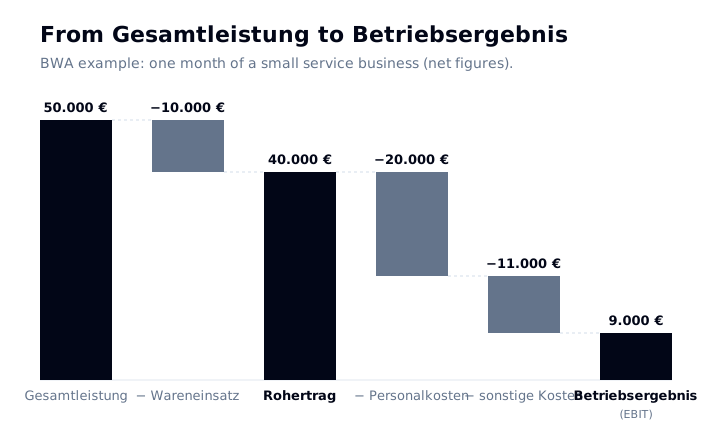
Here's a single month for a small service business — the logic applies to the self-employed and a GmbH alike:
| Line item | Amount | Ratio |
|---|---|---|
| Gesamtleistung (Total output) | €50,000 | 100% |
| − Material/COGS | €10,000 | 20% |
| = Rohertrag (Gross profit) | €40,000 | 80% |
| − Staff costs | €20,000 | 40% |
| − Rent | €3,000 | 6% |
| − Depreciation | €1,500 | 3% |
| − Other costs (advertising, vehicle, insurance …) | €6,500 | 13% |
| = Betriebsergebnis (EBIT) | €9,000 | 18% |
| +/− neutral result (interest) | −€500 | −1% |
| = Result before taxes | €8,500 | 17% |
From this single month you immediately read three things: the gross margin is 80% (typical for a service business), the staff cost ratio is 40%, and the net margin is 17%. Track those ratios over several months and you'll spot trends long before they surface in the annual accounts.
The Most Important BWA Metrics
The absolute euro figures say little until you put them in proportion. These four ratios give you the fastest read:
| Metric | Formula | What it shows | Orientation |
|---|---|---|---|
| Gross margin | gross profit ÷ total output | margin after direct costs | services often 80–100%, retail much lower |
| Material ratio | COGS ÷ total output | share of direct costs | the lower the better |
| Staff cost ratio | staff costs ÷ total output | burden of wages | hospitality ~35%, bakeries ~45%, pure services ~60% |
| Net margin (ROS) | result before taxes ÷ revenue | profit per €100 of revenue | the higher the better |
There is no universally "good" ratio. A 60% staff cost ratio is normal in a consulting business and alarming in a retail one. Get industry benchmarks from your tax advisor, chamber, or trade association — the comparison is what makes the number meaningful.
Which Types of BWA Exist?
Most people only know the standard BWA. DATEV and common bookkeeping software actually produce several reports that answer different questions:
- Short-term profit/loss statement (standard BWA, DATEV Form 01): the classic revenue/cost overview above — what most people mean by "BWA".
- Bewegungsbilanz (statement of changes): shows where funds came from and where they went (fixed and current assets, equity, liabilities).
- Statische Liquidität (static liquidity): at a reporting date, sets liquid funds and receivables against liabilities — the bridge to liquidity planning.
- Plan-vs-actual (Soll-Ist-Vergleich): compares your planned figures to actuals and exposes variances.
- Year-on-year and industry comparison: places the numbers in time and against competitors.
For day-to-day steering the standard BWA is enough. As soon as growth, financing, or a crisis is on the table, the Bewegungsbilanz and static liquidity views are worth a look.
How to Read a BWA Correctly
- Is revenue on track? Compare actual figures against your plan or the same month last year.
- Is gross margin holding up? Shrinking gross margins can signal pricing pressure or rising input costs.
- Are staff costs proportionate? Especially important if headcount has grown recently.
- Does the operating result match your expectations? Large surprises often point to missing bookings or misclassified expenses.
- Are there any one-off items? Unusual purchases or exceptional income can distort the monthly picture — mentally they belong in the neutral result.
Never look at a single month alone. The cumulative figures (year-to-date) and the year-on-year comparison show the trend — and the trend matters more than one good or bad month.
The BWA for Banks and Loans
When you apply for a business loan, an overdraft facility, or leasing, the bank will ask for a current BWA — usually together with the trial balance (Summen- und Saldenliste). Lenders use the BWA to assess your creditworthiness on an ongoing basis without waiting for the annual accounts. A clean, gap-free BWA is worth real money here: those who deliver reliable numbers every month get capital faster and on better terms.
The BWA and Tax Prepayments
The BWA also drives your tax prepayments. If your current operating result is significantly lower than last year, you can apply to the tax office for a reduction — as a self-employed person on your income tax prepayments, as a GmbH on your corporate income tax and trade tax prepayments. The BWA provides the documentary basis for that application — which directly improves your short-term cash position.
Common Mistakes When Reading a BWA
- Treating the BWA like the annual accounts. The BWA is preliminary and may have booking gaps — it's an early indicator, not a final result.
- Overlooking missing receipts. If incoming invoices aren't booked yet, profit looks too high. A suspiciously good result is often just a booking gap.
- Forgetting depreciation. If depreciation is only booked at year-end, the in-year result is too optimistic. Good BWAs spread it monthly.
- Looking at the month only. Without cumulative figures and a year-on-year comparison, you're missing the trend.
- Ignoring seasonality. A weak January means little if your business runs in Q4 — always compare against the same month last year.
FAQ
Is a BWA mandatory?
No. The BWA is an internal document — not subject to audit and filed nowhere. But banks and lenders ask for it regularly, and for steering your own business it's effectively indispensable.
Do the self-employed on EÜR need a BWA?
They're not required to, but they benefit just as much. A BWA (the "EÜR-BWA") can be produced from your ongoing EÜR entries, breaking income, expenses, and the preliminary result down month by month — ideal for steering your own business.
Are the figures in a BWA gross or net?
Net. VAT and input VAT are stripped out, because they're irrelevant to the company's economic position — they're pass-through items.
What's the difference between a BWA and a P&L?
The P&L is part of the official annual financial statements and determines the annual profit on a binding basis. The BWA follows the same logic but is monthly, preliminary, and for internal use only. More in our article on the profit and loss statement.
Who produces the BWA?
Traditionally your tax advisor, usually 2–4 weeks after month-end once all receipts are booked. With modern bookkeeping software you pull up-to-date figures yourself at any time — without waiting for the next appointment.
What is a certified (testierte) BWA?
A BWA the tax advisor confirms with a certificate — often together with the trial balance. Banks ask for it in lending decisions, because the stamp confirms the figures are reliable.
Personally, I only really track runway months. Everything else is the balance between growth ambition and confidence in your own cash flow.
 Peter BoykoFounder of Norman
Conclusion: Read Your BWA Every Month
The BWA is not red tape — it's the closest thing to a real-time financial dashboard you have, whether you're self-employed or running a GmbH. Those who read it monthly, understand the key ratios, and follow the trend rather than single months catch problems early, make better decisions, and face no surprises at year-end. Modern bookkeeping tools deliver the BWA up to date — with no delay.
Your BWA in real time — even as a freelancer
Norman generates your Betriebswirtschaftliche Auswertung automatically from your live bookkeeping — whether you're a sole proprietor on EÜR or a GmbH. Total output, gross profit and operating result are up to date every day, with no waiting for the tax advisor. The same figures flow straight into your tax prepayments and annual financial statements, so you run your business on real numbers instead of gut feel.