
Einnahmenüberschussrechnung (EÜR) in Germany 2026: Guide, Anlage EÜR & Deadlines
The EÜR is the standard simplified profit calculation for freelancers in Germany. Learn who must file it, what you can deduct, and how to do it step by step.
- Category
- Taxes
- Updated
- Author
- Diana
The Einnahmenüberschussrechnung (EÜR) is the simplest form of profit calculation in Germany. Anyone who is not required to keep double-entry books — freelancers, small traders, partnerships — uses it to determine taxable profit and files it as part of their annual income tax return. This guide covers what it is, who must file it, how to fill it in, and which deadlines apply in 2026.
Key Points at a Glance
- Formula: Business income − business expenses = profit (§ 4 para. 3 EStG). No balance sheet, no inventory.
- Who: Freiberufler (liberal professions) with no turnover limit, plus Gewerbetreibende up to €800,000 turnover and €80,000 profit per year (§ 141 AO). GmbHs and UGs cannot use the EÜR.
- How: Since 2017 the official Anlage EÜR must be submitted electronically via ELSTER — the tax office no longer accepts an informal list on paper.
- When: For tax year 2025, by 31 July 2026 (without a tax advisor) or 1 March 2027 (with one).
- Principle: What counts is the date money is received or paid (cash-basis / §11 EStG), not the invoice date.
What Is the EÜR?
The EÜR is a simplified profit calculation under § 4 para. 3 EStG. You set your business income against your business expenses — what's left is your taxable profit. Unlike double-entry bookkeeping, there is no balance sheet, no inventory, and no commercial ledgers.
The decisive rule is the cash basis (§ 11 EStG): income belongs to the year the money lands in your account, not the year you issued the invoice; an expense belongs to the year you pay it. One exception is the 10-day rule for regular recurring payments around the turn of the year.
Who Must File an EÜR?
Whether you file an EÜR or a balance sheet depends on your legal form and your thresholds:
| Who you are | Profit calculation |
|---|---|
| Freiberufler (liberal professions) | EÜR — no turnover or profit limit |
| Gewerbetreibende below the thresholds | EÜR available |
| Gewerbetreibende above €800,000 turnover or €80,000 profit | Balance sheet required (§ 141 AO) |
| Entered in the commercial register (e. K., OHG, KG) | Balance sheet required (§ 238 HGB) |
| GmbH, UG, AG | Always double-entry bookkeeping — EÜR excluded |
The €800,000 turnover and €80,000 profit limits have applied since the Wachstumschancengesetz for financial years from 2024 (previously €600,000 / €60,000). Only once you exceed them in two consecutive years does the tax office require you to switch — see the guide on moving from EÜR to balance-sheet accounting.
Structure of the EÜR
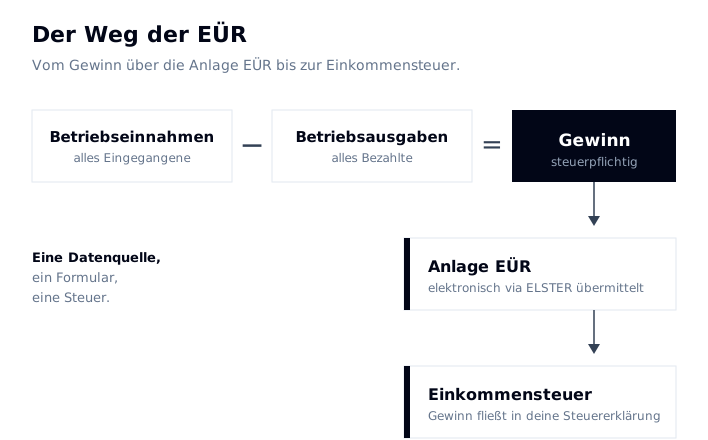
The EÜR has two blocks, queried line by line in the official Anlage EÜR:
Business income — all payments for your services: fees, invoiced amounts, reimbursements, collected VAT, and items withdrawn for private use. If you are VAT-registered, you enter net amount and VAT separately; as a small business (Kleinunternehmer) you enter gross amounts without VAT.
Business expenses — all costs incurred for your work: purchases, software, office supplies, rent, travel, phone, insurance, input VAT paid, and depreciation.
Profit = business income − business expenses
For the exact line structure and an Excel sample, see our EÜR template.
What Can You Deduct as Business Expenses?
Almost anything you demonstrably need for your work reduces your profit. The main items and their 2026 limits:
| Expense | What applies in 2026 |
|---|---|
| Home office | Daily flat rate €6/day, max. €1,260/year (= 210 days) — or proportional room costs for a dedicated study |
| Travel costs | €0.30/km, €0.38/km from km 21 — or actual costs |
| Hardware & software (low-value assets) | Immediate write-off up to €800 net purchase price |
| Equipment over €800 net | Depreciation over its useful life (AfA) in the fixed-asset register |
| Phone & internet | Up to 20% flat-rate, or actual business share |
| Professional development & literature | Fully deductible |
| Professional associations & liability insurance | Deductible as a business expense |
| Meals on business trips | Flat rate €14 (away 8–24 hrs) or €28 (full day) |
Equipment between €250 and €1,000 net can alternatively go into a pool depreciated over five years. More on the immediate write-off in the post on the low-value-asset threshold. Keep things separate: health insurance, retirement contributions, and donations do not belong in the EÜR — they go into the income tax return as special expenses.
The starter book for your self-employment
Free e-book: registration, accounting, your first invoice, and taxes — plus a tax calendar, deductions cheat sheet, and invoice template.
How to Create the EÜR Step by Step
1. Collect and categorize receipts. Keep all income documents (invoices, bank statements) and expense receipts organized. GoBD-compliant digital storage is valid — a photo of the receipt is enough if it's stored unalterably.
2. Record all income. List every business payment received during the year on a cash basis — separated by net and VAT if you are VAT-registered.
3. Categorize expenses. Assign each expense to a category matching a line of the official Anlage EÜR, so the form fills in without searching later.
4. Complete the Anlage EÜR. Transfer the totals into the official form. It walks you through every standard category and calculates the profit automatically.
5. Submit electronically. The Anlage EÜR is part of your income tax return and is transmitted together with it via ELSTER.
Anlage EÜR and ELSTER: the electronic requirement
Since the 2017 assessment period, the Anlage EÜR is mandatory for everyone calculating profit under § 4 para. 3 EStG — and it must be transmitted electronically and authenticated. The former option of an informal one-page calculation (for business income under €17,500) no longer exists. Even someone earning a few hundred euros on the side files the same form.
You can submit it free of charge via Mein ELSTER, with tax software, or directly from your bookkeeping. The tax office only accepts a paper filing in narrowly defined hardship cases.
Deadlines and Retention in 2026
| Tax year 2025 | Deadline |
|---|---|
| Without a tax advisor | 31 July 2026 |
| With a tax advisor | 1 March 2027 (28 Feb falls on a Sunday) |
File late and the tax office may charge a late-filing surcharge of 0.25% of the assessed tax per month (at least €25 per month).
Retention: With the Fourth Bureaucracy Relief Act (BEG IV), the retention period for accounting receipts was cut from ten to eight years as of 1 January 2025 (for all receipts whose 10-year period had not expired by the end of 2024). The records and the EÜR itself are still kept for ten years.
EÜR vs. Balance Sheet: What Applies to You?
For the vast majority of freelancers and small self-employed people, the EÜR remains the right — and simpler — choice for good: no annual financial statement, no mandatory tax advisor, no inventory. Only once your turnover exceeds €800,000 or your profit exceeds €80,000, or you register in the commercial register, does double-entry bookkeeping become mandatory. The exact process, including the transition profit, is explained in switching from EÜR to balance-sheet accounting.
The most common mistake we see in support isn't accounting. It's attribution. People put health insurance, retirement contributions, or the home office related to their employment into the EÜR when those belong in the income tax return. The EÜR is only your business — private costs and reimbursements have no place in it.
 Peter BoykoFounder of Norman
Frequently Asked Questions
Who has to file an EÜR?
Anyone calculating profit under § 4 para. 3 EStG: Freiberufler with no turnover limit, plus Gewerbetreibende, GbRs, and sole traders not required to keep a balance sheet (under €800,000 turnover and €80,000 profit). GmbHs and UGs are excluded — they always use double-entry bookkeeping.
Where do I find the Anlage EÜR?
In Mein ELSTER under "All forms → Income tax → Anlage EÜR," or as a PDF sample on the Federal Ministry of Finance website. But you may only submit it electronically, not as a printed PDF.
Do I need an EÜR as a Kleinunternehmer?
Yes. The small-business rule (§ 19 UStG) only exempts you from VAT, not from calculating profit. You file the same Anlage EÜR but enter gross amounts without VAT. Since 2025 the threshold is €25,000 prior-year turnover and €100,000 in the current year.
Can I do the EÜR myself — without a tax advisor?
Yes. With manageable income and expenses, the EÜR is easy to handle alone, especially with bookkeeping software that prepares the Anlage EÜR and transmits it via ELSTER. You only need an advisor once things get more complex — which also extends your deadline.
What happens if I make a loss?
If your expenses exceed your income, the EÜR shows a loss. It lowers your taxable income and can be offset against profits in later years via the loss carryforward — a valuable effect especially in the start-up phase.
Conclusion
The EÜR is manageable — but missed deductions and a missed deadline cost real money. With Norman's AI bookkeeping you record income and expenses continuously, receipts are automatically mapped to the right EÜR lines, and at year-end the Anlage EÜR is no longer a big project. Start free.
Your EÜR, ready at the push of a button
The EÜR is only painful if you reconstruct it in July from a shoebox of receipts. Norman records income and expenses continuously from your bank transactions, categorizes them by AI into the lines of the Anlage EÜR, and prepares the form for ELSTER. Bookkeeping and invoicing are free; the full tax scope including EÜR submission starts at €12/month.