
Meal Allowance in Germany 2026: Rates, Reductions and How to Calculate It
How much is the German meal allowance in 2026, how do you reduce it when meals are provided, and how do the self-employed and employees claim it? All domestic and foreign rates — with a worked example.
- Category
- Taxes
- Updated
- Author
- Diana
In a nutshell: the meal allowance at a glance
- What it is: The meal allowance (Verpflegungspauschale, also Verpflegungsmehraufwand or per diem) covers the extra cost of meals on a business trip as a flat rate — no receipts.
- Domestic rates 2026: €28 for a full day (24 hrs away) and €14 for arrival and departure days, as well as for single-day trips over 8 hours without an overnight stay. These figures have been unchanged since 2020.
- Reduction for provided meals: breakfast −€5.60 (20%), lunch and dinner −€11.20 each (40%) of the full daily rate.
- Three-month rule: at the same temporary work location you only get the allowance for the first three months.
- Abroad: country-specific rates set annually by the Federal Ministry of Finance — most recently as of 1 January 2026.
- Who claims it: the self-employed as a business expense in the EÜR, employees as employment expenses or tax-free via the employer. The amount is the same for both.
What is the meal allowance (Verpflegungspauschale)?
When you travel for work — to a client, a trade fair or an appointment in another city — you eat out, and that usually costs more than eating at home. The tax office recognises this extra cost without you having to prove every coffee and lunch individually. Instead of actual receipts, there is a fixed flat rate per travel day — the meal allowance (Verpflegungsmehraufwand). It is governed by Section 9 (4a) of the Income Tax Act (§ 9 Abs. 4a EStG).
Two things are decisive here:
- The amount is set in law and the same for everyone. There is no separate "freelancer meal allowance" and no bonus for employees: the self-employed and employees use identical rates.
- Only the flat rate counts — not the actual receipt. You need no receipts for food. Conversely, you cannot claim more even if your restaurant visit was actually more expensive.
The prerequisite is a temporary work assignment (Auswärtstätigkeit): you are working away from both your home and your primary workplace (your business or office). The meal allowance is therefore one of four building blocks of travel expenses — alongside transport, accommodation and incidental costs.
Meal allowance 2026: the domestic rates
For trips within Germany, two rates apply unchanged in 2026, tiered by how long you are away:
| Absence | Allowance |
|---|---|
| Full calendar day (24 hrs) | €28 |
| Arrival and departure day (multi-day trip) | €14 each |
| Single-day trip over 8 hrs (no overnight) | €14 |
The logic behind it:
- You get the full rate of €28 for every intermediate day of a multi-day trip on which you are away for a full 24 hours.
- You get the half rate of €14 on the arrival and departure day of a trip with an overnight stay — regardless of how many hours you were out on those days. There is no minimum duration here.
- For a single-day trip without an overnight stay, the half rate of €14 only counts if you are away for more than 8 hours. Under 8 hours, there is nothing.
These amounts have applied since 2020. The increase to €16 and €32 originally planned in the Growth Opportunities Act (Wachstumschancengesetz) was struck out again by the Bundestag in February 2024 — so for 2026 it remains at €14 and €28.
Calculating the meal allowance: reduction for provided meals
The actual arithmetic begins as soon as a meal is provided for you while travelling — the hotel breakfast, the catering at a trade fair, or a business dinner someone else pays for. Then you have to reduce the daily allowance. The reduction is always measured against the full daily rate of €28, never the half rate:
| Meal | Reduction from the full daily rate | Amount |
|---|---|---|
| Breakfast | 20% | −€5.60 |
| Lunch | 40% | −€11.20 |
| Dinner | 40% | −€11.20 |
How to calculate it step by step:
- Determine the daily rate: €28 (full day) or €14 (arrival/departure or single day).
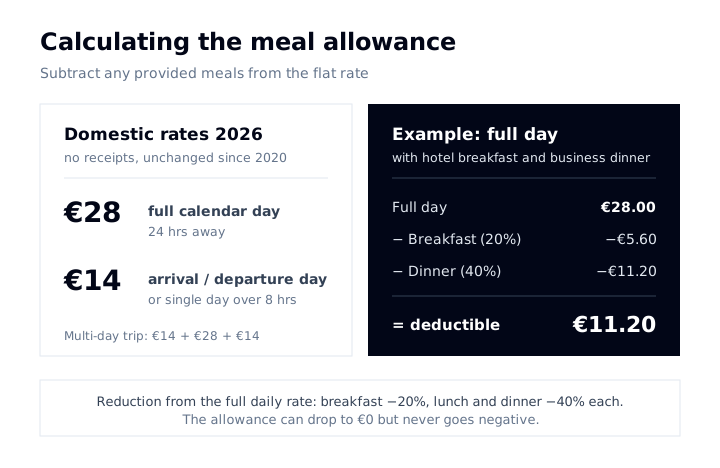
- Subtract provided meals: −€5.60 for each provided breakfast, −€11.20 for each lunch or dinner.
- The result is the deductible amount. It can drop to €0 but never goes negative.
Example 1 – a full travel day: You are away for 24 hours, the hotel provides breakfast and the client takes you to dinner. Then only €28 − €5.60 − €11.20 = €11.20 of the allowance remains.
Example 2 – arrival day with hotel breakfast: On the arrival day you are entitled to €14. Breakfast the next morning is still reduced by −€5.60 (20% of €28): €14 − €5.60 = €8.40.
The three-month rule
The meal allowance is only available for the first three months of a longer assignment at the same location. After that it lapses, because the tax office increasingly treats the site like a regular workplace for tax purposes — you have adjusted to eating there, so no extra cost is assumed.
Two points matter:
- The clock runs per location. If you change project or client, a fresh three-month period starts for the new location.
- A break of at least four weeks restarts the clock — whatever the reason the work at that location paused (holiday, illness, another project).
An example: if you support a client project three days a week for four months at the same site, you can only claim the meal allowance for the first three months. From the fourth month on, it is no longer available for that location.
The meal allowance abroad in 2026
If you travel abroad for work, higher, country-specific rates apply. The Federal Ministry of Finance (BMF) publishes them every year for over 180 countries; the current rates have applied since 1 January 2026 (BMF circular of 5 December 2025). They are structured like the domestic ones: a full daily rate and a half rate for arrival and departure days. An extract:
| Country (city) | Full day | Arrival/departure |
|---|---|---|
| Austria | €50 | €33 |
| France (Paris) | €58 | €39 |
| Netherlands | €58 | €39 |
| Italy (Rome) | €48 | €32 |
| Spain (Madrid) | €42 | €28 |
| Switzerland (rest of country) | €70 | €47 |
| Poland (Warsaw) | €40 | €27 |
| USA (New York City) | €66 | €44 |
| United Kingdom (London) | €66 | €44 |
Rates can vary by city within a country — Paris, for instance, has a higher rate than the rest of France. For a single-day trip abroad without an overnight stay, the rate of the last foreign place of work applies. The reduction for provided meals works exactly as it does domestically, just based on the relevant foreign rate: breakfast −20%, lunch and dinner −40% each of the full daily rate.
Important: there are flat rates for overnight stays abroad too, but only an employer may apply them in a tax-free reimbursement. The self-employed — and employees claiming a deduction — always use the actual hotel bill for accommodation.
Who claims the meal allowance, and how?
The rates are the same for everyone — only the route into the tax return differs:
- The self-employed and freelancers deduct the meal allowance as a business expense. It directly reduces the profit in the EÜR; the legal basis is § 4 (5) sentence 1 no. 5 EStG, which refers to the rates in § 9 (4a).
- Employees have two routes: either the employer reimburses the allowance tax-free via the travel expense report, or you claim it yourself as employment expenses (Werbungskosten) in Annex N — to the extent it was not reimbursed.
- GmbH managing directors are best off having the allowance reimbursed tax-free through the GmbH. Why that is almost always cheaper than the employment-expense deduction is explained in travel expenses for the self-employed and GmbHs.
One distinction that is often missed: the meal allowance only covers the extra cost of your own meals. If you invite business partners, those are entertainment expenses (Bewirtungskosten) — deductible at 70% under their own rules and requiring a proper entertainment receipt. More on this in our guide to deducting entertainment expenses.
The starter book for your self-employment
Free e-book: registration, accounting, your first invoice, and taxes — plus a tax calendar, deductions cheat sheet, and invoice template.
Record the allowance and don't overthink it — the rates are fixed, you just need to keep your travel days straight.
 Peter BoykoFounder of Norman
How Norman books the meal allowance
The most common mistake with the meal allowance is not the amount, but the bookkeeping around it: forgotten arrival and departure days, hotel breakfasts that weren't reduced, and a pile of receipts that draws attention at an audit. Norman captures every trip, applies the right rate, reduces provided meals automatically and books the allowance GoBD-compliant as a business expense in the EÜR — including the three-month rule per location.
Frequently asked questions
How much is the meal allowance in 2026?
Domestically, €28 for a full day (24 hours away) and €14 for arrival and departure days as well as single-day trips over 8 hours. These rates have been unchanged since 2020. Abroad, higher country-specific rates apply.
Do I need receipts for the meal allowance?
No. The allowance is granted regardless of what you actually spent on food — you need no receipts for it. Receipts are only required for transport, accommodation and incidental costs.
Do I get the meal allowance without an overnight stay?
Yes, on a single-day trip. The condition is an absence of more than 8 hours — then you are entitled to €14. If you are away for less than 8 hours, there is no allowance.
How is the allowance reduced for a free hotel breakfast?
A provided breakfast reduces the daily allowance by 20% of the full daily rate, i.e. by €5.60. On a full day that leaves €28 − €5.60 = €22.40; on an arrival or departure day, €14 − €5.60 = €8.40.
Can the self-employed claim the meal allowance?
Yes. For the self-employed and freelancers the meal allowance is a business expense and reduces the profit in the EÜR. The rates are the same as for employees — the term "freelancer meal allowance" refers to exactly this allowance.
What happens after three months at the same location?
After three continuous months at the same location the meal allowance lapses. A break of at least four weeks restarts the three-month clock.
Bottom line
The meal allowance is a simple, receipt-free tax benefit — once you know the rules. Remember the rates (€28 full day, €14 arrival/departure), the reduction for provided meals (breakfast −€5.60, lunch and dinner −€11.20 each) and the three-month rule. A clean travel expense report takes care of the rest. Read on: travel expenses for the self-employed and GmbHs · deducting entertainment expenses · taxes for freelancers 2026
The meal allowance, booked into your EÜR automatically
Norman captures every business trip, applies the right rate — full day or arrival and departure — and reduces provided meals automatically. The allowance lands in your EÜR as a business expense, filed GoBD-compliant. Invoicing and bookkeeping are free.