
VAT in Germany 2026: The Complete Guide for Businesses
In German, Mehrwertsteuer and Umsatzsteuer are the same tax — both mean VAT. This guide explains when you must charge VAT, how input VAT and the input-tax deduction work, what the VAT ID is, and when the small-business rule applies.
- Category
- Taxes
- Updated
- Author
- Diana
In Brief
- One tax, two names: Umsatzsteuer (official, per the VAT Act) and Mehrwertsteuer (colloquial) mean the same thing — VAT.
- Standard rate 19 %, reduced rate 7 %: you add VAT to your net prices and pass it on to the tax office — you are merely the "collector" for the state.
- Payable = VAT collected − input VAT: the VAT you pay on business expenses is deducted as input VAT. Only the difference goes to the tax office.
- Small businesses are exempt: with turnover below €25,000 (prior year) and €100,000 (current year), you can waive VAT entirely under § 19 UStG.
- You report it via the preliminary VAT return — electronically through ELSTER, usually by the 10th of the following month.
What Is VAT (Umsatzsteuer)?
VAT is a tax on the sale of goods and services. As a business, you add it to your net price, collect it from your customers, and forward it to the tax office (Finanzamt). Economically, the private end consumer bears it in the end — for you it is a pass-through item: you take it in and pass it on, it is not profit.
The correct name for it is "Umsatzsteuer", as stated in the VAT Act (Umsatzsteuergesetz, UStG). The word "Mehrwertsteuer" does not appear in the law at all — it is the colloquial term, because the tax ultimately only falls on the "added value" (Mehrwert) at each stage of the value chain. On invoices, both abbreviations, "USt." and "MwSt.", are common and permitted. For how the rates work and how to calculate them in practice, read the article on VAT rates and calculation.
Who Has to Charge VAT?
In principle, every entrepreneur who independently and regularly supplies services for payment is liable for VAT — whether freelancer, sole trader, GbR, UG, or GmbH. You then show VAT openly on every invoice and remit it. This is called standard taxation.
There are two rates: the standard rate of 19 % and the reduced rate of 7 % (§ 12 UStG), for example on food, books, and local transport. Which rate applies to your service is determined by law — when in doubt, the VAT-rates overview with the 7 % list helps.
There are two important exceptions to VAT liability:
- Small businesses under § 19 UStG: anyone staying below the turnover limits charges no VAT at all (more on this below).
- VAT-exempt supplies under § 4 UStG: certain services are exempt in principle, such as those of doctors, insurance brokers, or letting property.
A special case is the reverse-charge procedure (§ 13b UStG): for certain cross-border or construction services, the recipient owes the VAT instead of the supplier. You then invoice net without VAT and add the note "Steuerschuldnerschaft des Leistungsempfängers" (reverse charge).
Input VAT and the Input-Tax Deduction: the Heart of It
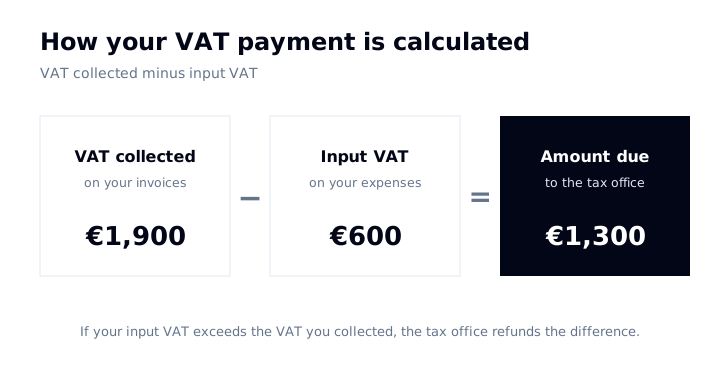
This is where VAT becomes decisive for businesses. You don't only collect VAT — you also pay it yourself, namely on your business purchases. This VAT you pay is called input VAT (Vorsteuer), and you may deduct it from the VAT you collected. The formula for your tax liability is:
VAT collected − deductible input VAT = amount payable.
An example: you charged your customers €1,900 in VAT and paid €600 in VAT yourself on software, office supplies, and the like. Then you transfer only the difference of €1,300 to the tax office. If your input VAT is higher than the VAT you collected, you get the difference back as a refund.
For the tax office to accept the input-tax deduction, you need a proper invoice with all mandatory details under § 14 UStG and VAT shown openly (§ 15 UStG). For invoices up to €250 gross (small-value invoices), simplified details suffice. How to get the most out of it is shown in the guide to the input-VAT deduction for the self-employed and GmbHs.
The VAT Identification Number (USt-IdNr)
The VAT identification number (USt-IdNr) is a separate number in the format "DE" plus nine digits. You need it as soon as you do business with companies in other EU countries — for example for VAT-free intra-Community supplies, for services to EU businesses, or for the recapitulative statement.
The difference from the regular tax number matters:
- The tax number (Steuernummer) is issued by your local tax office (Finanzamt) — it identifies you generally with the authorities.
- The VAT ID (USt-IdNr) is issued by the Federal Central Tax Office (Bundeszentralamt für Steuern, BZSt) — specifically for EU trade.
You can apply in two ways: as a new founder, you simply tick the box on the tax registration questionnaire (Fragebogen zur steuerlichen Erfassung), and the BZSt issues it automatically. Existing businesses apply directly via the BZSt online form. In addition, since late 2024 the tax administration is gradually introducing the new business identification number (Wirtschafts-Identifikationsnummer, W-IdNr); it is assigned automatically and does not replace the VAT ID.
The Small-Business Rule: When No VAT Applies
If your turnover is low, you can skip VAT entirely. The small-business rule under § 19 UStG exempts you if your turnover was below €25,000 in the prior year and does not exceed €100,000 in the current year. These limits, introduced in the 2025 reform, apply unchanged in 2026.
As a small business, you issue invoices without VAT (with a mandatory reference to § 19 UStG), file no preliminary VAT return — and, since the 2024 tax year, no annual VAT return either. The price for this: you also may not deduct any input VAT from your expenses.
Watch out for the €100,000 limit: since 2025 it is a hard limit. If you exceed it during the year, you become liable for VAT from exactly that transaction onward — immediately, not only the following year. For all the details, pros, and cons, see the guide to the small-business rule (Kleinunternehmerregelung).
Reporting VAT: the Preliminary Return (UStVA)
VAT is reported and paid via the preliminary VAT return (Umsatzsteuervoranmeldung, UStVA) — electronically through the ELSTER portal. How often you file depends on your payable amount from the prior year:
| VAT payable in the prior year | Filing frequency |
|---|---|
| up to €2,000 | exemption possible — annual return only |
| €2,000 to €9,000 | quarterly |
| over €9,000 | monthly |
The deadline is always the 10th of the following month. With a permanent filing extension (Dauerfristverlängerung), it shifts back by one month. We explain the full ELSTER process, the key field codes, and all the dates step by step in the guide to the preliminary VAT return and the overview of VAT deadlines 2026.
Accrual or Cash Accounting?
Exactly when VAT becomes due depends on your accounting method:
- Accrual taxation (Soll-Versteuerung, the default): you owe the VAT in the month you issue the invoice — regardless of whether the customer has paid yet.
- Cash taxation (Ist-Versteuerung, on request): you owe the VAT only once the money has actually arrived. This protects your cash flow.
You can apply for cash taxation if your prior-year turnover is below €800,000 (this limit also applies in 2026) — freelancers may use it regardless of turnover. Especially for young businesses, cash taxation is almost always the better choice.
Automate VAT with Norman
VAT is no rocket science, but it costs time and is error-prone — wrong rate, forgotten input VAT, missed deadline. Norman takes exactly that off your plate:
- The right rate automatically: Norman detects on every invoice and receipt whether 19 % or 7 % applies and books it correctly.
- Input VAT captured in full: incoming invoices are scanned, categorised, and assigned to input VAT — so you don't give away a single cent.
- UStVA from the same data: the finished preliminary return is filed directly with ELSTER, including current forms.
- Deadlines in view: Norman reminds you in good time so no late-filing penalty arises.
Frequently Asked Questions
When am I liable for VAT?
As soon as you independently and regularly supply services for payment, you are generally liable for VAT. You must then show VAT on your invoices and remit it. Exceptions are small businesses under § 19 UStG and certain VAT-exempt supplies under § 4 UStG.
What is the difference between Umsatzsteuer and Vorsteuer?
It is the same tax, just from two angles. Umsatzsteuer (output VAT) is what you charge and collect from your customers. Vorsteuer (input VAT) is the VAT you pay yourself on purchases. You offset the two: VAT collected minus input VAT equals your amount payable to the tax office.
Do I need a VAT identification number?
You need a VAT ID as soon as you exchange goods or services with companies in other EU countries. For purely domestic business, your regular tax number is enough. You can apply for the VAT ID free of charge from the Federal Central Tax Office or directly via the tax registration questionnaire.
What changed for the small-business rule in 2025?
Since 1 January 2025, the prior-year turnover limit is €25,000 (previously €22,000) and the current-year limit is €100,000 (previously €50,000). In addition, the turnover is now genuinely tax-exempt, and the €100,000 limit is a hard limit. These figures apply unchanged in 2026.
What happens if I exceed the small-business limit?
If you exceed €100,000 during the year, the exemption ends immediately — from exactly the transaction with which you cross the limit. From that moment you must show VAT, file preliminary returns, and in return may deduct input VAT. Sales before that stay tax-free.
What details does an invoice need for the input-tax deduction?
For the full input-tax deduction, the invoice must contain the mandatory details under § 14 UStG: full names and addresses, the issuer's tax number or VAT ID, invoice date and number, quantity and type of service, net amount, tax rate, and tax amount. For small-value invoices up to €250 gross, simplified details suffice.
Conclusion
VAT looks more complicated than it is: you add 19 % or 7 % to your prices, deduct the input VAT you paid yourself, and remit the difference to the tax office. Anyone staying below the small-business limits can skip it entirely. What matters is clean invoices, the full input-tax deduction, and the on-time preliminary return. With software that handles the rate, input VAT, and UStVA automatically, the tedious obligation becomes a matter of minutes. Read on: calculating VAT · preliminary VAT return · the small-business rule
VAT? Norman handles it automatically
Norman detects the correct VAT rate on every invoice and receipt, collects your input VAT, and prepares the preliminary VAT return from the same data — ready to file with ELSTER. Invoicing and bookkeeping are free, and you always keep your VAT payable and deadlines in view.