
German VAT Rates 2026: Rates, Calculation and Examples
Mehrwertsteuer and Umsatzsteuer are the same tax. Here you learn why there are two German names, which rates apply in 2026 (19 % and 7 %), which products are reduced-rate, and how to calculate VAT from net to gross and back.
- Category
- Taxes
- Updated
- Author
- Diana
In Brief
- Mehrwertsteuer = Umsatzsteuer: the same tax, two German names. "Umsatzsteuer" is the official term, "Mehrwertsteuer" the colloquial one. Both translate to VAT.
- Two rates in 2026: the standard rate of 19 % and the reduced rate of 7 % (§ 12 UStG) — both unchanged.
- 7 % applies to basic foods, books, newspapers, and local transport, among others.
- New since 1 January 2026: food in restaurants and cafés is permanently taxed at 7 % (drinks stay at 19 %).
- Quick maths: gross = net × 1.19. From the gross, you extract the VAT contained in it with 19/119 — so €100 gross contains just €15.97 in VAT, not €19.
Mehrwertsteuer vs. Umsatzsteuer: Two Names, One Tax
The short answer: there is no difference. Mehrwertsteuer and Umsatzsteuer denote one and the same tax. In the VAT Act (Umsatzsteuergesetz, UStG) only the term "Umsatzsteuer" appears — the word "Mehrwertsteuer" is nowhere in it. "Mehrwertsteuer" is the colloquial term, derived from the European value-added-tax system, because the tax ultimately only burdens the "added value" (Mehrwert) at each economic stage.
In everyday life you meet both abbreviations: a receipt usually says "MwSt.", a business invoice often "USt." — both are correct and equivalent. The tax authorities use "Umsatzsteuer", while retail tends to use "Mehrwertsteuer" toward consumers. For how to handle the tax as a business — input-VAT deduction, VAT ID, preliminary return — see the guide to VAT for businesses.
German VAT Rates 2026: 19 % and 7 %
Germany has two regular VAT rates, both set out in § 12 UStG and unchanged in 2026:
- Standard rate 19 % — applies to the vast majority of goods and services.
- Reduced rate 7 % — applies to selected everyday and cultural goods.
This is how the rate affects the price:
| Net price | + 19 % VAT | Gross price | + 7 % VAT | Gross price |
|---|---|---|---|---|
| €100.00 | €19.00 | €119.00 | €7.00 | €107.00 |
| €50.00 | €9.50 | €59.50 | €3.50 | €53.50 |
| €1,000.00 | €190.00 | €1,190.00 | €70.00 | €1,070.00 |
There is also a zero rate (0 %) for certain photovoltaic systems and a flat average rate for farmers and foresters (2026: 7.8 %). For most of the self-employed, though, only the 19 % and 7 % are relevant.
Which Products Have 7 %?
The reduced rate of 7 % is meant to relieve essential goods and cultural goods. These mainly include:
| At 7 % (reduced) | At 19 % (standard) |
|---|---|
| Basic foods (bread, milk, fruit, vegetables, meat) | Drinks, alcohol, many indulgence foods |
| Books, e-books, newspapers, magazines | Software, streaming, pure online services |
| Local transport (bus, train, taxi) and long-distance rail | Domestic flights |
| Tickets for theatre, concerts, museums, the zoo | Tickets for most theme parks |
| Hotel accommodation | Breakfast, minibar, and parking at the hotel |
| Plants, cut flowers, firewood | Fertiliser, garden furniture |
It gets curious at the edges: pet food carries 7 %, but baby food 19 %. Cow's milk is taxed at 7 %, an oat or soy drink at 19 %. And tap water costs 7 % tax, bottled mineral water 19 %. These distinctions regularly spark debate — when in doubt, Annex 2 to the UStG decides.
New in 2026: 7 % in Hospitality
One important change concerns restaurants and cafés: since 1 January 2026, food in hospitality is permanently taxed at the reduced rate of 7 % — whether eaten in, taken away, or delivered. This is set out in the new § 12 (2) no. 15 UStG (Tax Amendment Act 2025). Drinks expressly stay at 19 %.
For context: during the Covid relief, food was already taxed at 7 % once before. That exception expired at the end of 2023, so restaurant food was taxed at 19 % again from 1 January 2024. Since 2026 the 7 % is back — and this time without a time limit. For restaurateurs, bakeries, and caterers, this means noticeable relief on the VAT on their food business.
Calculating VAT: net, gross, and extracting it
Calculating VAT is pure percentage maths. You only need to know which direction you are calculating.
From net to gross (you know the price without tax):
- gross = net × 1.19 (at 19 %) or net × 1.07 (at 7 %)
- Example: €100 net × 1.19 = €119 gross
From gross to net (you know the final price):
- net = gross ÷ 1.19 (at 19 %) or gross ÷ 1.07 (at 7 %)
- Example: €119 gross ÷ 1.19 = €100 net
Extracting the VAT (you only want the tax portion):
- VAT contained = gross × 19/119 (at 19 %) or gross × 7/107 (at 7 %)
- Example: €119 gross × 19/119 = €19 VAT
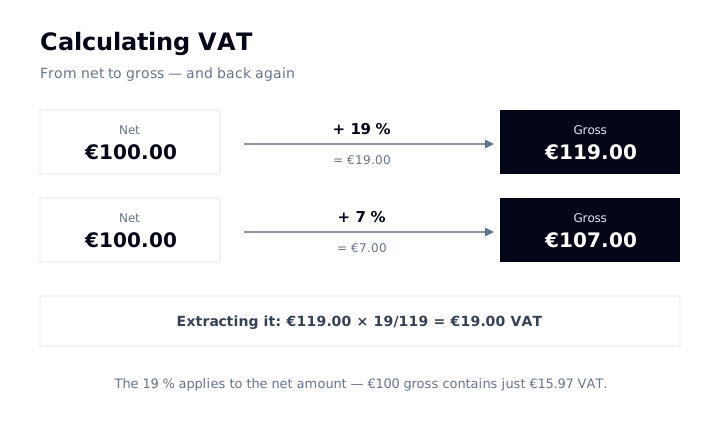
The most common mistake hides in the last step: €100 gross does not contain €19 of VAT, but only €15.97 (100 × 19/119). The 19 % always refers to the net amount, not the gross amount. This table shows it:
| Gross price | VAT contained (19 %) | Net price |
|---|---|---|
| €119.00 | €19.00 | €100.00 |
| €100.00 | €15.97 | €84.03 |
| €50.00 | €7.98 | €42.02 |
A lot of entrepreneurs multiply the gross amount by 0.81 to work out the net — but that's not correct. The right way is to divide by 1.19 to get the net.
 Peter BoykoFounder of Norman
VAT on Invoices and Receipts
On a proper invoice, VAT must always be shown openly: the net amount, the rate applied (7 % or 19 %), the tax amount in euros, and the gross amount. Only then can your business customer deduct the stated tax as input VAT.
There is a relief for small-value invoices up to €250 gross (§ 33 UStDV) — the typical till receipt: here it is enough to state the total amount and the tax rate; the tax amount need not be calculated separately. If you issue invoices as a small business, you show no VAT at all and instead note the reference to § 19 UStG.
Book VAT Automatically with Norman
The theory is simple — but in practice the right rate quickly becomes fiddly: 19 or 7 %, net or gross, and at month-end everything has to go into the preliminary VAT return. Norman does this for you:
- The right rate automatically: Norman detects on every invoice and receipt whether 19 % or 7 % applies.
- Net, gross, tax: amounts are split and booked correctly — no manual maths.
- Straight into your books: every entry flows automatically into your EÜR and preliminary VAT return.
- Invoices with the correct rate: issue invoices with the right VAT rate — free and unlimited.
Frequently Asked Questions
How do you calculate 19 % VAT?
You multiply the net amount by 0.19 to get the tax amount, or by 1.19 to get the gross amount directly. Example: €100 net × 1.19 = €119 gross, of which €19 is VAT.
How do you extract the VAT from the gross amount?
At 19 %, you multiply the gross amount by 19/119 (≈ 0.1597); at 7 %, by 7/107. Example: €119 gross × 19/119 = €19 VAT. You get the net amount by dividing the gross by 1.19.
Is the gross price with or without VAT?
The gross price is the final price including VAT — that is, what the customer pays. The net price is the amount without VAT. In business with consumers, gross prices are always shown.
When does 7 % apply instead of 19 % VAT?
The reduced rate of 7 % applies to certain everyday and cultural goods — such as basic foods, books, newspapers, local transport, and, since 2026, food in restaurants too. The list in § 12 (2) UStG and Annex 2 is decisive. Anything not listed there carries 19 %.
Why does €100 not contain €19 of VAT?
Because the 19 % refers to the net amount, not the gross amount. €100 gross contains €84.03 net and €15.97 VAT (100 × 19/119). If you subtracted €19, you would wrongly have calculated from the gross instead of the net.
What is the difference between Mehrwertsteuer and Umsatzsteuer?
None — it is the same tax. "Umsatzsteuer" is the official term from the law, "Mehrwertsteuer" the colloquial word. On invoices, both abbreviations ("USt." and "MwSt.") are permitted.
Conclusion
VAT is — despite its two names — a single tax with two rates: 19 % as standard, 7 % for selected goods such as food, books, and, since 2026, restaurant meals. The maths is simple once you know the direction: ×1.19 from net to gross, ÷1.19 back, and ×19/119 to pull out the tax contained. All that matters is hitting the right rate and cleanly distinguishing net from gross. Read on: VAT for businesses · preliminary VAT return · the small-business rule
Norman finds the right VAT rate
No more agonising over 19 % or 7 %: Norman automatically detects the correct VAT rate on every invoice and receipt, calculates net and gross correctly, and transfers everything straight into your bookkeeping and preliminary VAT return. Invoicing and bookkeeping are free.