
VAT on Invoices to Switzerland 2026: A German Business Guide (Third Country)
For VAT purposes Switzerland is a third country: if you run a freelance business, sole proprietorship or GmbH in Germany and invoice a Swiss customer, you usually charge no German VAT. When it is a VAT-exempt export, when the service is not taxable, how Swiss MWST works and when you must register there.
- Category
- Invoicing
- Updated
- Author
- Diana
The essentials at a glance
- Switzerland = third country: not an EU member, outside the EU VAT area and the customs union. Customs and import rules apply, not the EU single-market rules.
- B2B service to Switzerland: the place of supply is at the customer (§ 3a Abs. 2 UStG) → not subject to German VAT, no German VAT line. The Swiss customer accounts for the tax itself (Bezugsteuer).
- Goods supply to Switzerland: VAT-exempt export (§ 6 UStG) → no German VAT, but export proof is required. Swiss import tax applies on entry.
- Swiss MWST 2026: standard rate 8.1%, reduced 2.6%, accommodation 3.8% (unchanged since 2024).
- Registration in Switzerland: from CHF 100,000 worldwide turnover and supplies made in Switzerland — plus a Swiss fiscal representative.
- Buying from Switzerland: import VAT (19% or 7%) + customs duty; you deduct the import VAT as input VAT.
- No EU VAT ID, no EC Sales List, no OSS — all of that exists only inside the EU.
Switzerland = third country: why that changes everything
For VAT, the world is split into three zones: the domestic territory (Germany), the rest of the Community (the other EU states) and the third-country territory (everything else). Despite its location in the heart of Europe, Switzerland belongs to the third group — it isn't an EU member and lies outside the EU VAT area. Unlike Norway or Turkey, there's a second point: Switzerland is also not part of the EU customs union. So there are real customs formalities at the border, and goods are cleared on import.
For your invoice this means the EU mechanics fall away completely. There is no EU VAT ID for the Swiss customer, no EC Sales List and no OSS — all of that only exists in the EU single market. Instead the third-country rules apply: non-taxable services and VAT-exempt exports. You'll find the general basics in the third-country invoice guide; here we focus on the special case of Switzerland.
A practical note on customs: thanks to the free-trade agreement between the EU and Switzerland, many industrial and originating goods are duty-free — but only with a valid proof of origin (a supplier's declaration or an EUR.1 movement certificate). Swiss import tax is not waived by this, though: it's levied on top when the goods cross the border.
Invoicing Switzerland: first decide goods vs. service
Before you put a single figure on the invoice, settle two questions: are you supplying goods or providing a service? And is your customer a business (B2B) or a private individual (B2C)? That determines whether German VAT applies — and on what legal basis.
| Supply to Switzerland | German VAT | Basis | What to watch |
|---|---|---|---|
| Goods supply (B2B/B2C) | no — exempt | § 6 UStG (export) | export proof; Swiss import tax for the recipient |
| Service to a business (B2B) | no — not taxable | § 3a Abs. 2 UStG | note on the invoice; customer pays Bezugsteuer |
| Service to a consumer (B2C) | usually yes, 19% | § 3a Abs. 1 UStG | exceptions mainly for digital services |
So the two most common cases for German freelancers and companies — goods export and B2B service — both work without German VAT, but for two different legal reasons. The decision chart sums up which tax applies in which case:
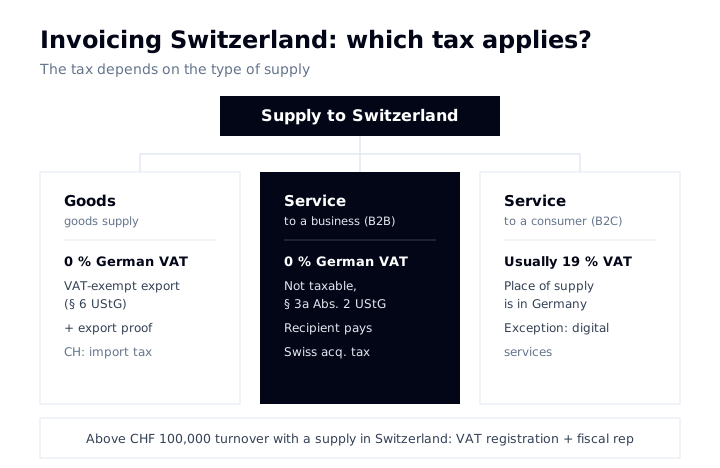
B2B services: not taxable — and the Swiss Bezugsteuer
If you provide a service to a Swiss business — consulting, IT, software development, marketing, design, graphics — the place of supply shifts to the customer's seat (§ 3a Abs. 2 UStG). The service is therefore not subject to German VAT: it doesn't appear as a taxable transaction in the German VAT system at all, and you charge no German VAT.
In place of your German VAT, the Swiss Bezugsteuer (acquisition tax) applies — the Swiss counterpart to the reverse-charge procedure. Your Swiss customer accounts for the MWST on your service itself and pays it to the Federal Tax Administration (ESTV). That's convenient for you: you invoice net, the rest is the recipient's job. A useful distinction: a Swiss customer who isn't MWST-registered owes Bezugsteuer only once they buy more than CHF 10,000 of foreign services in a year — but that's their obligation, not yours.
In your VAT return you enter the sale as a non-taxable other service in line 41 (code 45) — not in the line for VAT-exempt exports. For more on the right allocation, see the VAT return guide. The invoice carries your own tax number or VAT ID; you don't need a number from the Swiss customer, since the EU VAT ID only exists inside the EU.
Goods supplies: a VAT-exempt export
If you supply goods to Switzerland, the supply is VAT-exempt as an export under § 4 No. 1a in conjunction with § 6 UStG — but only if you provide export proof. This runs via the electronic ATLAS procedure: an electronic export declaration is mandatory above a goods value of €1,000 (or 1,000 kg); below that an oral declaration at the customs office of exit usually suffices. As proof you receive the exit certificate as a PDF once the goods cross the border — keep it for your books, because without it the exemption falls away.
Unlike a service, a goods supply is not "not taxable" but "exempt" — a subtle but important difference. In the VAT return the export therefore goes in a different line: line 24 (code 43). On entry into Switzerland the goods are cleared and Swiss import tax applies (8.1% or 2.6%), usually borne by the Swiss recipient as the importer.
The right note on the invoice
An invoice to Switzerland without a VAT note is incomplete. Which sentence belongs on it depends on the transaction — and because your customer is in Switzerland, it's best to add it in English too:
| Case | Note on the invoice |
|---|---|
| B2B service | "Not subject to German VAT (§ 3a Abs. 2 UStG)" |
| Goods supply | "VAT-exempt export under § 6 UStG" |
| Pointer to Swiss Bezugsteuer (optional) | "Reverse charge / Steuerschuldnerschaft des Leistungsempfängers" |
You show the amount net — without German VAT. You may invoice in any currency, including Swiss francs. For your books and the VAT return, however, you convert the amount to euros at the official monthly rate of the German Federal Ministry of Finance (§ 16 Abs. 6 UStG); the details on foreign-currency conversion are in the general third-country guide.
Free invoice template (PDF, Word & Excel)
Legally compliant with all mandatory fields under §14 UStG — three formats, ready to use.
Swiss value-added tax (MWST) 2026: the rates
Switzerland levies its own value-added tax (MWST) with markedly lower rates than Germany. These rates have applied since 1 January 2024 — under the AHV-21 reform — and remain unchanged in 2026:
| Rate | 2026 level | Applies to |
|---|---|---|
| Standard rate | 8.1% | most goods and services |
| Reduced rate | 2.6% | food, books, newspapers, medicines |
| Special accommodation rate | 3.8% | overnight stays incl. breakfast |
For most German businesses these rates only matter in two situations: when you have to register in Switzerland (then you charge Swiss MWST) or when you buy from Switzerland and MWST shows up on the incoming invoice. For a normal invoice to a Swiss customer the MWST is irrelevant — you charge no tax at all.
When do you have to register for MWST in Switzerland?
In the normal case you do not have to register in Switzerland — B2B services and goods exports run without a Swiss tax number. But there are situations in which Switzerland treats you as liable. The threshold: a worldwide turnover of at least CHF 100,000 — combined with supplies deemed to be made in Switzerland. Typical triggers:
- Work on site: assembly, installation, construction or trade work physically carried out in Switzerland.
- Mail order (small consignments): anyone shipping at least CHF 100,000 of small consignments per year from abroad into Switzerland counts as a domestic supplier and becomes MWST-liable. A small consignment is one where the import tax is below CHF 5 — i.e. goods up to roughly CHF 62 at the standard rate or about CHF 193 at the reduced rate. From registration onward all consignments count as domestic supplies, and you remit Swiss MWST (but can deduct the import tax as input tax). Since 1 January 2025, platform taxation (Art. 20a MWSTG) shifts this obligation to the platform for sales via online marketplaces.
If you become liable in Switzerland, you must appoint a fiscal representative with a seat or residence in Switzerland. Registration runs via an online form of the ESTV and must happen within 30 days of exceeding the threshold; the administration can also demand a security deposit (3% of domestic turnover, minimum CHF 2,000, maximum CHF 250,000). At the latest here, a tax adviser specialising in Switzerland pays off.
Buying from Switzerland: import VAT and customs
The reverse direction is just as common: you buy goods or services from Switzerland. Because Switzerland is a third country for customs, you treat the import like a supply from the US or China.
- Buying goods: on import, import VAT (19% or 7%) and possibly customs duty arise. The customs declaration is usually handled by the freight forwarder; you receive an import-duty assessment listing all charges. You deduct the import VAT you paid as input VAT (§ 15 Abs. 1 Nr. 2 UStG) — provided the import is for your business and you're named in the assessment.
- Buying services: if you buy a service from a Swiss business, the reverse-charge procedure applies in Germany (§ 13b UStG): you owe the German VAT but, where entitled to input-VAT deduction, claim it back in the same breath — a zero-sum game overall.
Common mistakes on invoices to Switzerland
- German VAT charged. A B2B service or a goods export carries no German VAT — charge 19% anyway and you owe it under § 14c UStG.
- "Not taxable" confused with "exempt". Service = not taxable (line 41), goods export = exempt (line 24). Wrong line, wrong VAT return.
- Export proof forgotten. Without the exit certificate the goods supply isn't exempt — the tax office reclaims the VAT.
- EC Sales List or OSS for Swiss sales. Both only apply in the EU. For Switzerland they're simply wrong.
- Swiss registration overlooked. Anyone assembling on site or shipping small consignments above the CHF 100,000 line becomes liable in Switzerland.
- Francs not converted. CHF amounts must be converted to euros for the books at the official rate, not the payment rate.
Frequently asked questions
Do I charge VAT on an invoice to Switzerland?
In most cases no. For B2B services the supply is not subject to German VAT (§ 3a Abs. 2 UStG), and for goods exports it's exempt (§ 6 UStG). You show the net amount and add the matching VAT note. German VAT only arises for B2C services whose place of supply is in Germany.
Is Switzerland a third country?
Yes. For VAT and customs, Switzerland is a third country: not an EU member, outside the EU VAT area and the customs union. That's why export and import rules apply instead of the EU single-market mechanics with VAT ID and EC Sales List.
How high is VAT in Switzerland in 2026?
The standard rate is 8.1%, the reduced rate 2.6% (for food, books and medicines, for example) and the special accommodation rate 3.8%. These rates have applied since 1 January 2024 and are unchanged in 2026.
When do I have to register for MWST in Switzerland?
As soon as your worldwide turnover reaches at least CHF 100,000 and you make supplies deemed to be in Switzerland — such as on-site assembly or mail order with small consignments above the CHF 100,000 line. You then need a Swiss MWST number and a fiscal representative based in Switzerland.
What is the Swiss Bezugsteuer?
The Bezugsteuer (acquisition tax) is the Swiss counterpart to the reverse-charge procedure. When a Swiss business buys a service from abroad, it accounts for the MWST itself and pays it to the ESTV. You as the German supplier invoice net; the Bezugsteuer is your customer's responsibility.
Do I need a VAT ID for Swiss customers?
No. The EU VAT ID exists only inside the EU. For an invoice to Switzerland your own tax number or VAT ID is enough; there is no number for the Swiss customer and none is needed.
Conclusion
For VAT, Switzerland is a third country — and that simplifies a lot once you keep the two main cases apart: a B2B service is not subject to German VAT (§ 3a Abs. 2 UStG, line 41), a goods supply is exempt (§ 6 UStG, line 24, plus export proof). In both cases you charge no German VAT, add the right note to the invoice and convert francs at the official rate. Swiss MWST (8.1% / 2.6% / 3.8%) only concerns you once you're registered there or buy from Switzerland yourself. And remember: no VAT ID, no EC Sales List, no OSS — all of that stays in the EU.
Invoices to Switzerland without VAT mistakes
Norman recognises Switzerland as a third country from the customer address, leaves off German VAT, adds the right note (§ 3a Abs. 2 UStG or VAT-exempt export), converts Swiss francs to euros at the official rate and books the sale to the correct UStVA line. Your VAT return stays clean — whether you invoice a Swiss group, an agency or an online customer.